THE DOCTOR WHO RATINGS GUIDE: BY FANS, FOR FANS

|
BBC
Arachnids in the UK
|

|
| Story No. |
306 |
|
| Production Code |
Series 11, Episode 4
|
| Dates |
October 28,
2018
|
With Jodie Whittaker, Bradley Walsh, Tosin Cole, Mandip Gill
Written by
Chris Chibnall
Directed by
Sallie Aprahamian
Executive Producers: Chris Chibnall, Matt Strevens, Sam Hoyle
|
|
Synopsis: Giant spiders have taken over a Sheffield hotel.
|
Reviews
Spiders in Sheffield by Niall Jones
17/9/26
In the end, the spiders were never the real problem. They may have grown to an unnatural size, infested a luxury hotel and captured several people (to be eaten later), but none of this was their fault. They didn't ask to be turned into monsters. They never even posed a long-term threat, as their excessive growth would have eventually killed them. No, the real problem was always Jack Robertson.
Brash, paranoid and interested only in money and reputation, Robertson represents everything the Thirteenth Doctor is not. An ultra-wealthy American property developer with designs on the White House, he more than a little resembles Donald Trump. Arachnids in the UK is far less satirical than the appearance of such a Trumpian character would suggest, but the appearance of such a villain in 2018 certainly felt contemporary. It also garnered some praise. In a four-star review, one of only two given to a Series 11 episode, critic Patrick Mulkern highlighted Robertson as 'the best bad guy in ages'.
By the sounds of it then, Arachnids in the UK should be pretty good. After all, 'giant spiders attack a luxury hotel' sounds like a classic Doctor Who plot --- a little B-movieish, perhaps, but sure to be good fun. The appearance of a compelling human villain, someone for the Doctor to furiously debate with and battle against, should be the icing on the cake.
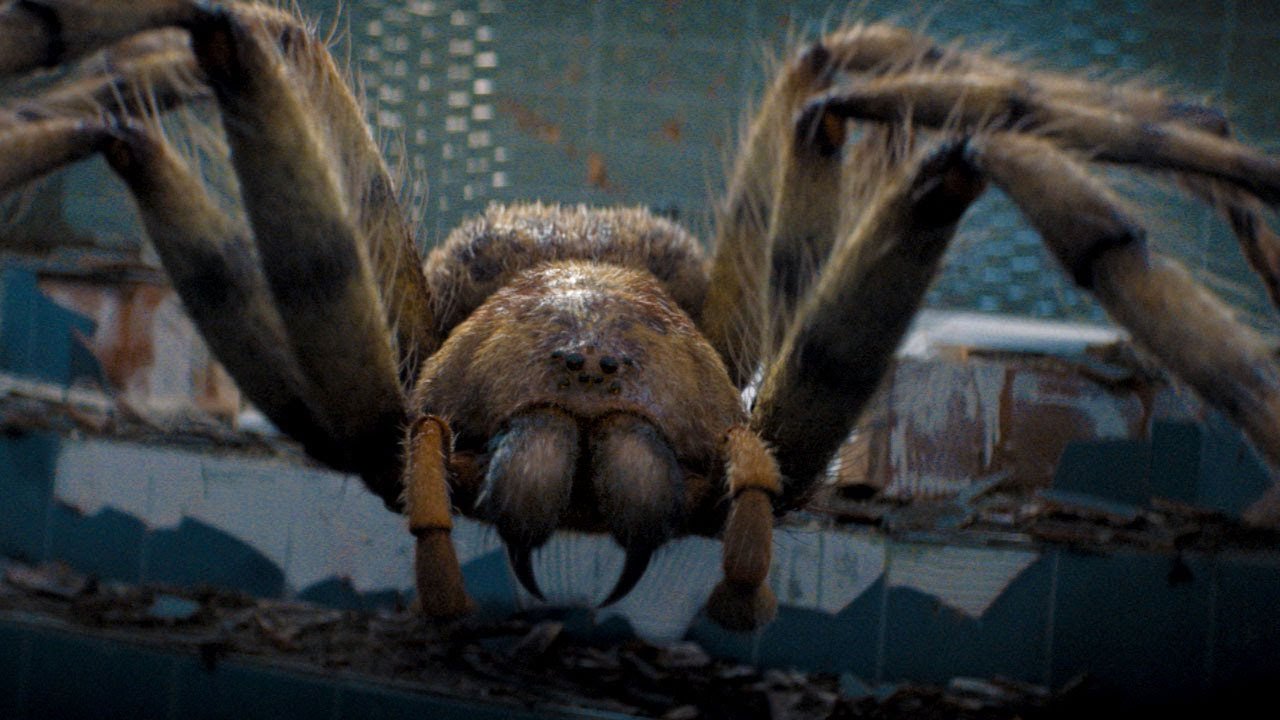
Except it isn't. Arachnids in the UK is not good. It may not be a complete disaster, but far from being a highlight of Series 11, as the Radio Times review would suggest, it is in fact a representatively bad example of a Chris Chibnall-era story, containing a fair smattering of the flaws common to his time as head writer. There are occasional flashes of quality --- and the spiders themselves are terrifyingly well-realised via CGI --- but the script suffers from an excess of exposition and concludes in a way that is both sudden and unsatisfying.
It turns out that there are two ways to get rid of giant spiders. The Doctor and friends lure most of them into Robertson's safe room, using a combination of homemade spider repellent and 'Sheffield's sickest grime station', while Robertson simply shoots the largest one dead. This is supposed to be an exercise in contrasts, with the Doctor's humanitarian methods shown up favourably against Robertson's brutal ways. However, the script doesn't support this interpretation and the moral difference between the Doctor's and Robertson's actions is far less clear-cut than the Doctor's outrage would suggest.
The spider that Robertson shoots was already dying, its growth causing it to be unable to breathe properly. The shots of it pawing against the wall of the hotel ballroom, clearly in pain, are genuinely distressing, and the spider goes from being an object of fear to an object of pity. While it's not addressed directly, it is implied that the spiders herded into the safe room would also suffer a similar fate --- or possibly just eat each other. The shot of Robertson killing the spider is also upsetting, but it's not clear that his action necessarily deserves the Doctor's outrage. In another story, this moment could have introduced a serious and thorny moral debate: is it worse to actively cause suffering or to enable it through inaction? Here, however, the script barely even acknowledges the problem. Robertson may describe his action as 'a mercy killing', but the Doctor's response --- 'I see no mercy in you' --- is clearly intended to be a withering put-down to which there can be no reply. Robertson is so firmly established as the villain that the audience is expected to oppose anything he says or does merely on principle. Unsurprisingly, the fate of the remaining spiders proved controversial among fans --- including for spider-loving actress Katy Manning, who otherwise praised the episode in the Radio Times, but acknowledged that the spiders' fate 'really upset me'.
At this point in the episode, Chibnall reaches a moral conclusion that should be uncontroversial --- killing is bad --- but which is not supported by his own script. He introduces an ethical dilemma and almost completely ignores it. This could be an unintended side effect of the episode's educational remit. Arachnids in the UK is stuffed with facts about spiders, from the strength of their silk to ways to repel them, and even credits a scientific advisor, Dr Niall Doran from the University of Tasmania. It is possible, therefore, that Doran may have explained to Chibnall that, in reality, the spiders would not be able to survive for long at such a large size and that Chibnall worked this fact into his script without properly thinking through its consequences for his story.
This isn't the only issue with the ending, however. Having killed the giant spider and been scolded by the Doctor, Robertson walks off and out of the story. Not for the first time, the Thirteenth Doctor proves unable to defeat a villain. Robertson also gets off scot-free in his second appearance, Revolution of the Daleks, which is doubly odd, while allegations of sexual assault against actor Chris Noth precluded a third encounter.
The effect of this is to make the Thirteenth Doctor look impotent and ineffective. At worst, this has the unfortunate effect of making the first female Doctor seem inferior to her male counterparts. Chibnall, however, may have had good reason for letting Robertson off the hook. You could argue that the world of real-life politics is so outside the world of Doctor Who that defeating a Trump analogue would amount to nothing more than wish-fulfilment. It's a legitimate, if somewhat downbeat interpretation, but not having the Doctor even fully confront such a character does call into question the wisdom of including him in the first place. Moreover, the Doctor has brought down far more sinister and powerful political figures in the past, from the Collector in The Sun Makers to Helen A in The Happiness Patrol. Russell T Davies was also not afraid of killing off obvious analogues of real-life politicians during his initial stint as head writer, from fake Tony Blair in Aliens of London to fake George W Bush in The Sound of Drums. This suggests that the decision to make Robertson so recognisably like Trump --- a figure who is, somewhat jarringly, namechecked within the episode itself --- was a mistake, as it raised expectations that the story was unwilling to meet.
In truth, Robertson's resemblance to Trump is largely superficial. While his position as a property developer turned politician does suggest parallels, his role in the story is not especially political. Robertson's dialogue does include some Trumpian moments --- telling Yaz's mum Najia that 'you're fired', the line 'how's that for fire and fury?' --- but the extent to which he seems like Trump stems mainly from Noth's performance; with his big hand gestures and odd pauses, he clearly modelled his performance on Trump. But even this is less substantial than initially appears. These mannerisms seem borrowed more from Alec Baldwin's impressions of Trump on Saturday Night Live than from the man himself. They're a shorthand, a joke with the audience. In the episode, Robertson doesn't even behave that much like Trump. He's a different kind of villain --- a right-wing American, for sure, but, for the most part, calmer and more rational than the 45th president. All this means that Arachnids in the UK is not actually that satirical. Its main political point, in an obvious piece of American bashing, is that guns are bad, an uncontroversial (at least in the UK) point that Chibnall nevertheless manages to bungle.
The frustrating thing about all this is that Arachnids in the UK actually gets off to a good start. The opening scene, with its low camera angles and discordant music, is nicely ominous, while the scene in which Yaz's family is introduced is both charming and amusing. Busybody mum Najia, conspiracy theorist dad Hakim and sarcastic sister Sonya are all believable and likeable characters --- with enough foibles to inspire sympathy for Yaz's desire to get away from them. Having the Doctor come for tea also allows Jodie Whittaker to show off another side of her character. While the Thirteenth Doctor is often compared (not always favourably) with David Tennant's Tenth Doctor, here she appears more like Matt Smith's Eleventh. Like him, she effectively captures the Doctor's status as an awkward outsider, someone trying to do an impression of a normal person and failing badly. Her attempt at small talk ends with her rambling on about sofas: 'I could get a purple one. And sit on it.'
Looking at where Arachnids in the UK appears within Series 11, the decision to return to Sheffield makes sense. Despite the decision to market the series as something of a soft reboot, the first few episodes closely follow the pattern laid out by Davies in Series 1: a contemporary opener, a trip to the future, a trip to the past, then home. At a character level, Arachnids in the UK is about the Doctor's companions returning to their ordinary lives and deciding that they don't want to live them anymore. Having been unwittingly blasted into space at the end of The Woman Who Fell to Earth, this episode gives them the chance to choose to travel in the TARDIS for themselves. Introducing Yaz's family shows the counterpart to this, but it's a shame that, aside from a few more glimpses of Sonya, we don't get to meet them again.
Coming after three episodes that showcase different visions of where Chibnall-era Doctor Who might go, Arachnids in the UK attempts to show the series doing a traditional Doctor Who story, one possibly inspired by The Green Death. Unfortunately, this attempt largely proves to be a failure. While the visual effects are impressive, with the spiders likely to give arachnophobes nightmares, the script itself is muddled and the attempts at satire have little bite. The Radio Times may have given it four-stars, but, for this reviewer, Arachnids in the UK deserves only two.