THE DOCTOR WHO RATINGS GUIDE: BY FANS, FOR FANS

|
BBC
Boom
|

|
| Story No. |
338 |
|
| Production Code |
Series 14 Episode 3
|
| Dates |
May 18,
2024
|
With Ncuti Gatwa, Millie Gibson
Written by
Steven Moffat
Directed by
Julie Anne Robinson
Executive Producers: Russell T Davies, Julie Garner, Jane Tranter, Joel Collins, Phil Collinson, Julie Anne Robinson, Steven Moffat
|
|
Synopsis:
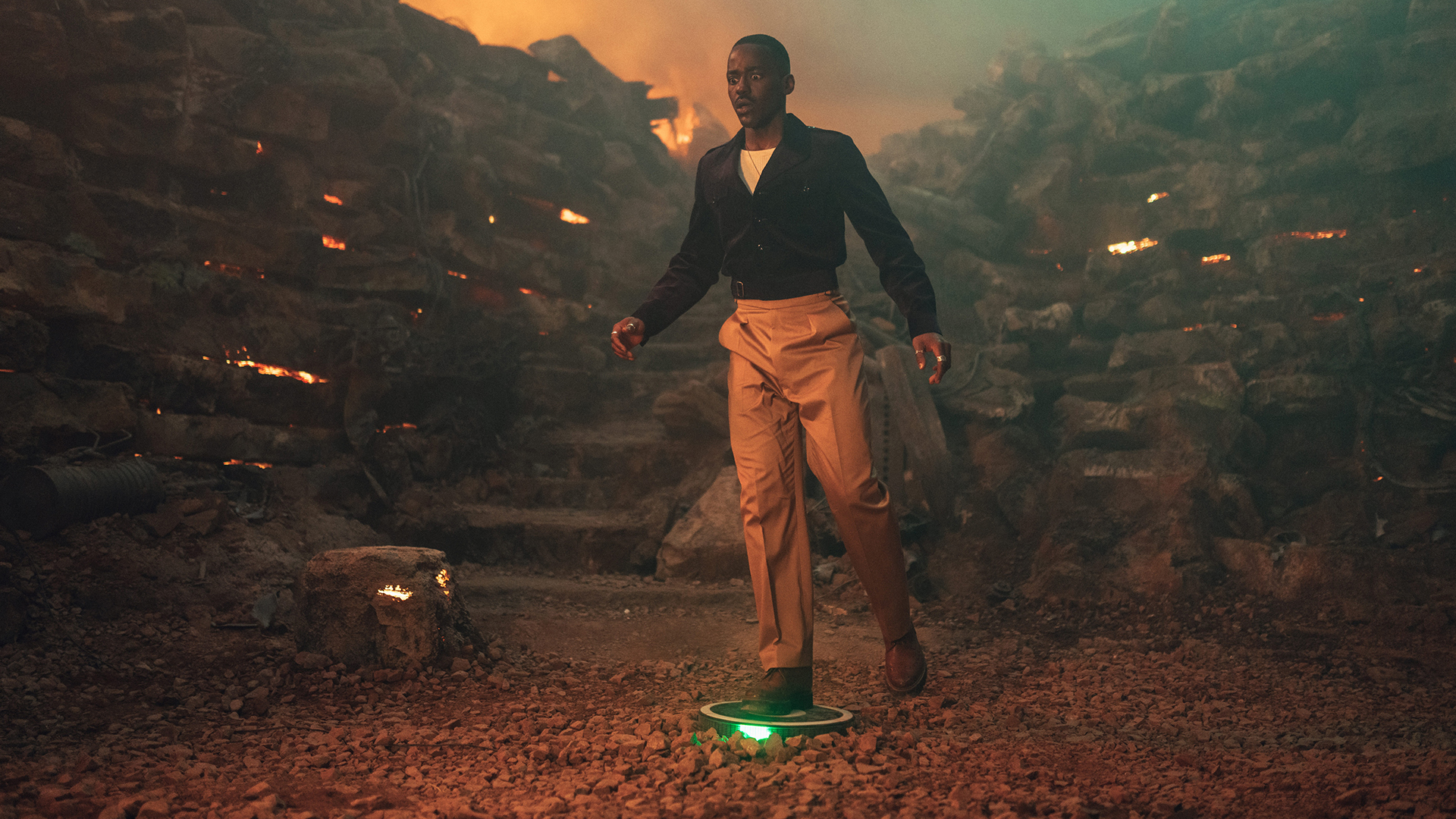
The Doctor accidentally steps on a mine in the middle of a battlefield.
|
Reviews
"Dad Skills" by Hugh Sturgess
1/9/26
Now that the funny thing called the Gatwa era has come to an all-too-sudden end, among its many problems I think that one of its biggest is the same as the era preceding it, that this was a Doctor who never really came together as a character, and as a result the era never got going. And with seasons being so short now, there's less time than ever for a season to "get going" after a slow start.
While Boom isn't my favourite episode of the Gatwa era but it is Ncuti Gatwa's tour de force as the Doctor. Its premise centres the episode almost solely around the Doctor (which comes at a cost to Ruby, more on that below) and the extreme situation lets Gatwa play to his strengths of taking his performance to the extremes of emotional intensity. Other scripts do frequently let him do this --- the end scene of Dot and Bubble is an obvious highlight --- but all too frequently Gatwa's reactions feel excessive. Yes, I'm talking about the crying every week. Boom is virtually alone (in fact, I think literally alone) in giving Gatwa a situation dire enough that his operatic performance of terror and despair are appropriate, and he absolutely sings. If the final scene of Dot and Bubble is, as El Sandifer put it, the acting equivalent of a guitar solo, Boom is an acting symphony.
The script is perfect for this, precisely because Moffat has blatantly written the Doctor as Capaldi. The result is rather like an unusual cover of a song you love: the lyrics are there, but it's also a brand new thing. Moffat's Doctor, particularly the twelfth, is a layered character. The Doctor is the character the nameless Time Lord who ran away with a stolen TARDIS aspires to be. Moffat's era is full of little moments where the Doctor is shown to calibrate his "performance" to reassure his companions, or to reflect what he believes "the Doctor" should do. In contrast, Gatwa grounds his performance in raw emotion and humanity. The result of trying to perform Moffat's carefully mannered model of the character in such an open, emotional way is positively electric.
One of the most Moffat-y lines in the script is the Doctor being able to estimate the weight of Vater's "urn" to the sixth decimal place just by seeing Ruby throw it in the air, and admitting he was "trying not to show off". You can imagine how Matt Smith would have delivered it, as an offhand shrug. Capaldi would have blustered it in an a harried way. Gatwa gives it a snarky, annoyed scowl, the same as his later delivery of "faith gyal". It's hard to imagine another Doctor displaying quite such a flash of genuine annoyance in this way.
Other Doctors would have played the whole situation a lot cooler. The episode's tension wouldn't work without Gatwa's perpetual anxiety and dread. The initial failed attempts to stay cheerful and reassuring, the several moments of disorganised terror, his near hysteria when he thinks Ruby is dead but is explaining the situation to her anyway ("Huh? Do you get it? Huh? Do you get it? Do you get...? Do you get it?")... Gatwa almost singlehandedly serves as the barometer of the episode's stakes.
However, I must say that Gatwa's crying has become a little too much of a meme to be taken seriously, even here.
Moffat also just writes Ruby as Clara, and Millie Gibson gives her best performance after her debut. Occasionally she delivers the dialogue so much like Jenna Coleman that it's eerie (her not-insubstantial facial similarity with Coleman doesn't help), but, as with Gatwa, it's the differences that are so compelling. Clara was composed and always in control, while Gibson's chief way of playing Ruby is chaotic panic and improvisation, so seeing her handle a moment where Ruby takes charge and orders the Doctor around (on rewatch, I was astonished she didn't actually say "Doctor, do as you're told") is fascinating.
Where were these characters in the rest of the season? Boom really throws into sharp relief that these characters otherwise never feel like they're pushed anywhere extreme. At the end of the season, all life in the universe is extinguished and, aside from a big scream from the Doctor, their reactions are mostly glum acceptance (and yet more tears from Gatwa). I wonder if the production schedule was too fast for RTD to learn from what worked and what didn't --- Gatwa's big emotional swings in Series 15 (such as his absurd brain-snap in The Interstellar Song Contest) don't play to his strengths the way Boom does.
While Boom is an incredible showcase for Gatwa and Gibson, sadly overall it's a deeply flawed episode, and one of Moffat's weakest.
As I suggested above, the episode ends up not treating Ruby well, fake-killing her two-thirds in and leaving her functionally a corpse at the climax. This is a recurrent problem in the Gatwa era --- note how Ruby was similarly irrelevant to the climax of her debut, Space Babies and The Devil's Chord, and the way Belinda is so often sidelined in Series 15 --- but it was also a recurrent problem in the Whittaker era, which cluttered up the TARDIS with companions who contributed nothing to the resolution of any episode. The show has just failed to properly use its companions for the better part of a decade now. Especially as a new companion, who traditionally has been the emotional core of a season's opening episodes, Ruby is weirdly peripheral in the beginning of Series 14. Being just a lump of meat with an arc hook attached for the climax of Boom is just an exaggerated version of this problem.
This is part and parcel of an episode that frankly falls apart a bit at the climax. The episode so meticulously ramps up tension for almost its entire run, which is then suddenly deflated with a resolution that leans way too heavily on a combination of technology-is-magic and the Power of Love, which manages to feel both incoherent and saccharine. Vater's AI, which previously amounted to a holographic voicemail message of him that is substantially inferior to real-life chatbots, suddenly becomes an unstoppable computer virus that somehow survives being "permanently deleted" and completely shuts down Villengard's "algorithm" (the way the episode uses this word reminds me of Classic Who's perennial confusion between galaxies, solar systems and constellations) --- all because of Vater's fatherly love for his daughter. I honestly wouldn't have so much of a problem with this if this didn't feel like an absolute arse-pull, and one that renders the previous forty minutes kinda irrelevant in their own story. Vater singlehandedly defeats Villengard with only the barest involvement of the Doctor. Isn't he then the actual main character, whose arc from Version 1.0 chatbot to sentient super-virus is the actual driving force of the episode? It doesn't help that Splice is the episode's problem character, played by an actress clearly too old for the part as written, so what should be the episode's emotional core inspires annoyance rather than sympathy.
The reason this feels like an arse-pull is that it has nothing to do with the carefully established ways the situation can be resolved. When Ruby is mortally wounded, Mundy says that only an ordained Anglican priest can receive treatment. The Doctor tells Mundy that the only way to save themselves is to surrender. It turns out that actually there was a hitherto undiscussed third option: an extremely rudimentary AI (who, to this point, has not displayed a trace of Vater's personality beyond a pre-recorded "kiss kiss") can become sentient, convert itself into a computer virus, survive being "permanently deleted" somehow and defeat the entire corporation. It's not just rushed, it feels like an episode that got away from the author and needed to be ended in a hurry.
One of Moffat's great strengths as a plotter is that he can make endings feel like natural culminations of what has come before. A perfect example is from Forest of the Dead, when the Doctor realises his future self "saved" River the way Cal saved the patrons of the Library, in itself set up by the "ghosting" of the archaeologists in the previous episode. The final twist is meticulously set up by what came before. So when Mundy said Ruby could be treated only if she was an Anglican, one's mind goes naturally to the fact that Ruby was left on the steps of a (presumably) Anglican church on Ruby Road. In an episode that quotes (either literally or thematically) from so many of Moffat's previous episodes and those of his era, the notion that the marines need to surrender to win echoes the Doctor defeating the Foretold in Mummy on the Orient Express by surrendering to it. Yet these ideas are, you might say, permanently deleted; instead Vater just rewrites the finale to end neatly and suddenly.
The episode's interest in faulty algorithms and non-existent monsters is, I am confident, a deliberate attempt by Moffat to emulate the themes and ideas of his episodes written for the first RTD era, ones like The Empty Child and The Girl in the Fireplace. Unfortunately, they are so vague and sketchy that they feel more like Moffat karaoke than something from the man himself. I don't mind that the apparent business model of Villengard --- selling weapons that attack their own buyers to generate further demand for weapons --- is a ludicrous idea that makes no sense. Satire like this works by exaggeration. For instance, given the use of the term "thoughts and prayers", you could say that this is how the American gun industry works: they sell weapons that lead to gun crime, which justifies selling more weapons.
The problem is that it's so unclear how exactly this is working that it makes the satire feel toothless. (For example, did the weapons the marines fired as "warning shots" come back and hit them? If not, how did the war against no one happen? Did no one really notice they were firing on themselves? If this is standard procedure, surely this is happening all the time?) It's hard to see this as a cutting attack on the military-industrial complex when it relies on the marines being complete idiots. It feels like a phoned-in combination of Moffat's standard interest in systems gone wrong and the recent tendency of pop entertainment to offer lukewarm condemnations of capitalism without any particularly penetrating insight.
I think for some fans, Doctor Who expressing anti-capitalist opinions is vital, not because they actually believe this will change anything, but because they think it's the bare minimum for a moral person in 2026. I find this both incredibly self-defeating (alienating the vast majority of people who don't spend every waking moment thinking about politics, while convincing those who do that everyone already agrees with them) and also lazy, since it leads to stuff like this, which goes through the anti-capitalist rhetorical motions without trying to make the criticism work or to say anything new. (Contrast this with Oxygen, which sells its equally caricatured anti-capitalist message with the killer line "We're fighting the suits.")
The standard set for Moffat was impossible. This is a guy who by consensus wrote the best ever episode of Doctor Who, with the only debate being whether that episode was Blink, Heaven Sent, Day of the Doctor or The Doctor Falls. I think Boom would be noticeably weak and undercooked no matter who got its byline. But it being by Moffat makes it hurt all the more. How fundamentally flawed must an era of Doctor Who be that even Moffat the GOAT can't stick the landing?