
Damaged Goods
Damaged Goods

|
Damaged Goods |
Big Finish Productions Damaged Goods |
|
| Adapted by | Jonathan Morris | 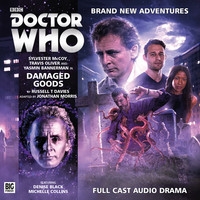 |
| Format | Compact Disc | |
| Released | 2015 |
| Starring Sylvester McCoy, Yasmin Bannerman and Travis Oliver |
| Synopsis: The year is 1987 and there's a deadly new narcotic on the streets of London. As part of their investigations the Doctor and his companions Chris and Roz move into the Quadrant, a rundown housing estate. An ancient alien menace has been unleashed, a menace somehow linked to a local gang leader known as The Capper, a charmed young boy called Gabriel and his mother Winnie, the enigmatic Frei Foundation, and Eva Jericho, a woman driven to the brink of madness. As London descends into an apocalyptic nightmare, the Doctor must uncover the truth about the residents of the Quadrant and a desperate bargain made one dark Christmas Eve. |
Damaged Goods Returned by Matthew Kresal 17/11/15
Almost twenty years ago, and nearly a decade before he became the man who regenerated Doctor Who on TV for a new century, Russell T Davies made his first contribution to the series in an entirely different medium. At a time when Doctor Who was off the air and being continued via the Virgin book ranges, a then-up-and-coming Davies would write his one and only novel for the New Adventures. Long out of print, the novel has found a new lease of life from Big Finish Productions with a new audio drama adaptation of it. How well does it stack up, both as an adaptation and as a production in its own right?
The novel has a reputation for being one of the best novels to come out of the Wilderness Years, so expectations were pretty high for this release. That said, I read the novel a couple of months or so ago finally and must be one of the few people who wasn't overawed with it. The novel suffered from a number of problems including pacing and the fact that, while Davies painted beautiful portraits of his own characters, he largely relegated the TARDIS crew to the sidelines. The novel tone was also far darker than anything Davies did with Doctor Who on television (indeed, the novel felt more like Torchwood at times) and Davies himself stopped it being reprinted ahead of the New Series airing in 2005 for just that reason. So it was surprising to see that Big Finish had been allowed to tackle it, but tackle it they did.
The entire thing works because of a superb adaptation by Jonathan Morris. Morris not only keeps much of Davies' original dialogue and plot but also manages to work some of Davies' wonderful prose into the script as well. The novel's haunting opening pages are wonderfully transformed into a monologue that opens the first disc with the character of Bev Tyler relating events instead. It's also wonderful to hear Sylvester McCoy actually saying the dialogue Davies wrote way back in the 1990s, and Morris keeps some of the best Doctor moments from the novel in place, such as sequence where the Doctor explains why the Quadrant (the housing estate where much of the story takes place) is like a series of little fortresses. Morris also does a wonderful job of fixing one of the main issues I personally had with the novel, which is putting the TARDIS crew at the center of events rather than having them as supporting characters for much of the story's length. The result being that this particular version of Damaged Goods works even better than the original did.
Perhaps more surprising is how faithful to the original novel it is where tone is concerned. Damaged Goods may give us familiar Davies territory with a Tyler family, a housing estate and homosexual characters, but the tone of the novel wasn't so much Doctor Who but that of Torchwood (especially the bleak but brilliant Children of Earth). Everything revolves around drugs and family secrets playing out on a 1980s London housing estate, and this version doesn't shy away from that. A particular drug, and what is lurking within it, is still at the heart of the tale. The fictional drug Smile is substituted for the cocaine that was in the original, though it isn't hard to read between the lines. Much of the violence and body horror of the novel is here as well, perhaps made even worse because of what can be managed on audio where everything is left to the imagination of the listener. While some of the darkness is toned down to a certain extent, and much of the more explicit language is deleted, the essence and feeling is still there and the main body of the story isn't affected. The result is that one can still get the flavor of the original novel from listening to this.
There are some changes of course. Morris streamlines much of Davies' plot, which, given how sparse the plot of the novel is, isn't a bad thing. The character of Eva Jericho, and especially what causes her actions, is simplified a bit, which also isn't a bad thing given the running time restrictions and the fact the audio couldn't easily do the appendices that Davies put into his original novel. Two of the biggest changes though revolve around elements that were part of the arc that was running in the novels at the time which, due to the other novels not being adapted, are replaced with something that those familiar with Davies' work on the New Series will undoubtedly recognize (and, like me, will likely punch the air when they hear them). There's also some altering of the ending as well, with some changes to exactly who survives at the end (apparently done at Davies' own request based on the recent Doctor Who Magazine article about the story) which does make it end of a slightly better note. None of which hurts at all.
Morris' adaptation is just one part of what makes this work so well. A large chunk of it is the performances. It's wonderful to hear McCoy bringing this slightly darker version of the Seventh Doctor to life and there are moments, such as the aforementioned conversation about the Quadrant, which he just does beautifully. This release is also the audio debut of novel range companions Chris and Roz, played by Travis Oliver and Yasmin Bannerman respectively, both of whom are brought to life wonderfully. There's a very strong supporting cast with the various members of this particular Tyler family (Michelle Collins as the mum Wendy, Georgie Fuller as Bev and Tayler Marshall as Gabriel) being standouts. Denise Black has the unenviable task of bringing Eva Jericho - a character that is brilliantly written but so easy to play wrongly as a simply insane woman - to life and rises to the challenge splendidly. The one sour-note in the supporting cast is Daniel Brocklebank as David who perhaps overplays one important, defining part of that character to the point of being cringe worthy at times. On the whole though, it's a superb cast.
Last, but certainly not least given that this is an audio production, is the sound design and music. Big Finish stories always stand out in this category, not matter how good or bad other elements might be, but Damaged Goods especially excels. Howard Carter does an excellent job bringing the Quadrant and the less fashionable side of 1980s' London to life here which, when combined with the score and a glorious new version of the Doctor Who theme, gives the entire two-hour production a real cinematic feeling. It's one of the best post-production jobs Big Finish has done to date on any production, which, given the high standards of the company's output, is saying something.
Damaged Goods is well worth seeking out. As an adaptation of the original Russell T Davies' novel from 1996, it's superb as it condenses the novel into a two-hour package while also holding onto much of the flavor and characters that make it stand out while also improving it in the pacing department. As a Big Finish story, it's also superb, with a combination of elements that give it the true feeling of being a Doctor Who movie without the pictures. Even if you haven't read the original novel, this is well worth a listen as it might be not just the best Big Finish Doctor Who release so far this year but a rare case of an adaptation improving upon the original source material.
"Think about this! What would a mother do? What would any mother do?"I'll be honest. As a younger Doctor Who fan, growing up with NuWho, I never knew about the Virgin New Adventures till quite a few years later, and I always planned to read them at some point. To this day, I still haven't managed to do that, but I thought the next best thing was to listen to one of the few adaptations Big Finish have managed to gain the rights to. What better place to start than quite possibly one of the range's best-regarded audios?
The Seventh Doctor, Chris and Roz, arrive at the Quadrant, a troubled council block in Thatcher's Britain. There's a new drug on the streets, a drug that's killing to a plan. Somehow, the very ordinary people of the Quadrant are involved. And so, amidst the growing chaos, a bizarre trio moves into number 43. The year is 1987: a dead drug dealer has risen from the grave, and an ancient weapon is concealed beneath human tragedy. But the Doctor soon discovers that the things people do for their children can be every bit as deadly as any alien menace - as he uncovers the link between a special child, an obsessive woman, and a desperate bargain made one dark Christmas Eve.
The 90s Doctor Who ranges seemed to ever increase the adult themes. Damaged Goods is no exception, with some truly dark and disturbing material exploring drug use, psychotic episodes, sexuality and body horror. Major props have to go to Jonathan Morris and his incredibly difficult job of condensing a nearly 280-page novel down to two-hour audio, managing to throw in a couple of changes that better tie Damaged Goods to Russell T Davis' era of the show. The entire cast is on top form, but if I had to pick some standouts, it would either be Sylvester as 7 who truly comes into his own and delivers one hell of a devoted performance or Peter Barrett as the Capper. He gives off this truly spine-chilling performance that left me with goose bumps more than once. The soundscape is truly something else; Howard Carter's rendition of the theme coupled with his amazing musical score makes for a truly unique experience, one that makes for both easy listening and a fundamentally horrific atmosphere.
If I had any gripes about this one, it's the fact that the final few minutes are a bit messy, and it's very easy to get lost in the scene due to the way the events unfold, but that remains the only detracting element from this otherwise near-perfect update of Russell's original novel. Overall, Damaged Goods is one of 7's best audios and contender for best of his entire library, one I would happily revisit; hopefully next time in book format.
9/10
A Review by Jacob Licklider 9/3/26
Adapting Damaged Goods into an audio drama form was always going to be a difficult task as the story is highly acclaimed by many for its dark story and bleak atmosphere. It gets bleak enough that it could have been heavily censored to make it appropriate for children, but Big Finish decided to pull out all the stops and have Jonathan Morris adapt it into an audio drama format. Jonathan Morris is a writer who is not afraid to push the boundaries of Doctor Who, taking one of the novels into an audio drama where boundaries can be pushed even further. Yet Morris did tone down the audio just a little bit from its novel counterpart. The body count is much less, with four more characters surviving to the end, some characters being cut completely (Mrs. Hearn and Carl Tyler), and the death of the Capper being changed from setting himself on fire to jumping off the roof of a parking garage. I cannot fault Morris for making these changes, along with toning down the more sexual elements of the novel for the audio, as some of them even help with the story. Cutting Mrs. Hearn helps when it is revealed how alone Winnie Tyler feels; changing the Capper's death makes the story feel a bit more realistic; and while they did tone down Chris and David's relationship, it still has the full gravitas of the public view of homosexuality at the time.
The script is already in favor of the adaptation, but if this really works better than the book, you need to look at the direction, music and acting of the story. Ken Bentley has his work cut out for him, as this audio has to introduce us and the actors to the characters of Chris and Roz, as this is the first of their stories to be adapted into audio. Bentley does pull it off as he works with Oliver and Bannerman to embody their characters. Oliver plays up Chris's naivete as Bannerman works off of him with Roz's signature brand of pessimism. Bentley must be commended for the way he directs the opening of each part of the audio, telling the prologue of the novel from the perspectives of Bev and Winnie Tyler so we can get the full story. Horror elements seep through in several places as Bentley lingers on disturbing imagery of the graveyard scene, Mr. Jericho's death by rat-poisoned potatoes (which is performed in gruesome detail) and how the N-forms have been invading the world. Yes, the drug is changed from generic cocaine to SMILE, but that makes the story feel more unique, as it makes the search for it a bit easier. The novel could have had the Doctor get the wrong consignment of cocaine, but here all SMILE is contaminated. Howard Carter scores the audio adaptation using a single piano and ambient sounds, which emulates almost a dark Christmas story. The score is haunting and only adds to the tension of the story as events escalate from bad to worse in the second half.
Sylvester McCoy as the Seventh Doctor gives a performance to rival the one in Master and The Curse of Fenric. The Doctor feels like someone who is in a deep depression, which works with the dark tone of the story. His interactions with Gabriel Tyler are also better by simply having McCoy be performing the story. The supporting characters are all done really well and can be easily imagined in these roles. I've already touched on the performances from Chris and Roz, who make a great first impression, but it is the rest of the supporting cast that make the impact. Tayler Marshall, who was fifteen at the time of recording, does a great job as Gabriel Tyler, which is down to Ken Bentley being able to direct children. Marshall gives Gabriel that air of mystery the role deserves and the ambiance of someone more powerful than we are ever led to believe. It's just as chilling as the turn from Peter Barrett as the Capper who balances this mix of over-the-top ham with subtlety. The performance embodies the insanity of the character well with the flip-flopping of personalities.
The real stars of the story are Denise Black and Michelle Collins as Eva Jericho and Winnie Tyler, respectively. Black as Eva Jericho captures the madness of the character and while her plotline is scaled back a bit to work in the two-hour format, that improves the meaning of the title. While the novel makes it an arbitrary aspect of Mrs. Jericho's personality, the adaptation shows it better as the sign of her madness as she believes Steven is damaged goods, needing to be returned to the store. That scene, the killing of her husband and her takeover of the N-form at the end are all wonderfully performed as you get the sense of mania in her head. Michelle Collins as Winnie Tyler on the other hand actually gives that warm motherly feel from her performance, and if her scenes at the beginning of Part Two don't make you wish her to use that blood money, nothing will, as she has suffered greatly for her children.
To summarize, Damaged Goods is another example of Big Finish perfecting the flaws on an already great storyline. Sure people may be disappointed that things were changed, but most of these things are minor details and only take place right off screen as they do get referenced in the audio. Everything in this one is perfect from the acting, the writing, the adaptation, the haunting score and the direction. 100/100