
The Dark Planet

|
|
Big Finish Productions The Dark Planet |
|
| Written by | Brian Hayles, Matt Fitton | 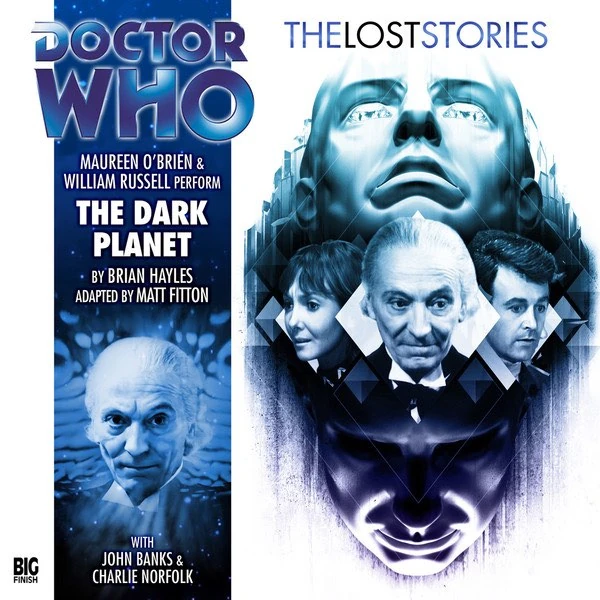 |
| Format | Compact Disc | |
| Released | 2013 |
| Starring William Russell, Maureen O'Brien |
| Synopsis: Somewhere far back in the early days of the universe, the TARDIS lands on a world lit by a dying sun. Missing from the Doctor's star maps and dotted with strange crystalline statues, it is a world ripe for exploration. But it is also a world of destruction. Venturing out onto its surface, the time travellers find themselves drawn into an age-old conflict between the two species residing on the planet: people of Light and Shadow. Proving a catalyst for the escalation of the conflict, the Doctor and his friends need either to create a peace or to pick a side. Because in times of war, nothing is ever black and white. |
The Charge of the Light Brigade by Jacob Licklider 5/10/25
The Lost Stories were supposed to end after the third season with The Rosemariners, but the extras on that release hinted that a search would be in order to see if Big Finish were able to scrounge up some more scripts to adapt into audios. Luckily, four scripts were found to make up a fourth season. Released in the Fiftieth Anniversary Year for Doctor Who, these four Lost Stories went back to the eras of the first three Doctors to provide an end to the range. The first of these is The Dark Planet, which while written in the 1960s feels like something Andrew Cartmel would write. Hayles originally wrote the story to be the fifth story in the second season, but it wasn't made for a very simple reason. While it is an instance of hard science fiction with amazing concepts and highly relevant themes, it could never be realized on a budget of even the most expensive films of the 1960s. Much like The Web Planet, The Dark Planet is an experimental story whose only humanoid characters are the main cast and the rest of the characters are living embodiment of light and shadows. It's a story rooted in pulp fiction of the time, and it wears it proudly on its sleeve.
The story is about the futility of war and how communication, or a lack thereof, can prolong conflicts and drive even the best sorts of people to the depths of depravity. The two factions in the war are the Lights and the Shadows. The Lights live in a city of crystal and take crystalline forms when the need is required. They are a people of science who are in a bad way as they have been at war with the Shadows for the longest amount of time. It also has a message of not judging people by outward appearances much like Galaxy 4, but the story never really goes above that message. The Lights are actually committing awful acts, preparing to kill themselves so they can save their planet and defeat the Shadows, while the Shadows, a minimal presence in the story, just want to talk things through and share in the Lights' glory. The depravity of the story is reflected on by the Doctor, who acts very human in the story.
William Russell of course is brilliant at imitating William Hartnell, and that helps, as the Doctor wishes almost to be able to change history and allow the science of this early age to live on. Of course, this is an impossibility as the course of history cannot be changed, and the consequences will be severe if there is even a slight change. Hayles and Fitton make these scenes in the story be extremely tense, as the atmosphere, which is already very alien, feels very tense. For once, you really don't know what is going to happen and whether the main crew are going to make it out of the situation in one piece.
William Russell also reprises his role as Ian Chesterton, and while he always gives a good performance, he doesn't have much to do in this story which is a detriment to the plot as only the Doctor really has a good presence. Maureen O'Brien's Vicki however has much more to do, as she makes friends with one of the Lights, which is how Fitton and Hayles decide to reveal the darker nature of the planet to the audience, which is a great way to pull it off, as we are allowed to see the good and the bad along with tension. A lot of the tension comes from the images of things you see in your head and what you don't notice. Take, for example, one of the cliffhangers, which reveals that a Shadow has made it into the city because it hid in the Doctor's black cloak. On television, this would come out of nowhere as everyone has a shadow, but in your head you imagine the lack of shadows, which really does work.
To summarize, The Dark Planet is just as ambitious as The Web Planet, but it is for the best that this story was stuck in an audio format. The effects required to adequately adapt the script to the screen would never have been realized. The story itself has some great messages, but the pacing is such a slow burn like a lot of the 1960s stories while the characters don't do much. 78/100