THE DOCTOR WHO RATINGS GUIDE: BY FANS, FOR FANS
| Story No. |
301 |
|
| Production Code |
Series 10, episode 12
|
| Dates |
July 1,
2017
|
With Peter Capaldi, Pearl Mackie, Matt Lucas
Written by
Steven Moffat
Directed by
Rachel Talalay
Executive Producers: Steven Moffat, Brian Minchin.
|
|
Synopsis: Two Masters find themselves facing their impending regenerations.
|
Reviews
Where There's Tears, There's Hope by Niall Jones
16/9/25
Before every finale, a cliffhanger. Something big and terrible has been revealed. The nature of the story has fundamentally changed. It becomes an epic, as previously unseen armies of Daleks appear, Daleks emerge from a mysterious sphere, or exterminate the Doctor. Sometimes, it's not even the Daleks. Maybe it's the Master, revealed as having been hiding in plain sight all along. The big twist in the last five minutes of Utopia, in which the kindly Professor Yana is revealed as the Master, remains one of the best in the New Series. And, for all the Chibnall era's many flaws, the shock appearance of the Master at the end of Spyfall Part 1 was one of the few times that it felt genuinely exciting and unpredictable.
The ending of World Enough and Time, in which John Simm's Master literally unmasks himself, therefore fits comfortably into this tradition. It's a stunning moment, marking the first time that two iterations of the character have shared a screen. On first broadcast, however, the surprise was dented by the BBC's decision to include the Master in a trailer for the series. While this was undoubtedly a misstep, robbing the final scene of some of its immediate impact, the significance of the reveal extends beyond mere shock value.
In creating Missy, Steven Moffat had already radically reimagined the character, positioning her as ambivalently amoral --- a warped reflection of the Doctor, rather than a cackling megalomaniac. By resurrecting an earlier iteration of the Master, specifically one who was characterised very much as a cackling megalomaniac, and placing him alongside her, Moffat creates a point of comparison that not only reveals the extent to which Missy has developed as a character but which also reflects on the Master more generally.
One thing that has characterised the Master in pretty much all their appearances since 1970's Terror of the Autons is their schemes, baroque plans usually involving ridiculous disguises and unlikely alliances with alien races. What makes The Doctor Falls unusual is that the Master spends the episode without a plan. True, his presence on the colony ship is revealed to have been part of a typically power-hungry scheme and he did spend all of World Enough and Time disguised as a caretaker, but much of the actual plotting took place offscreen. Despite an attempt to kill the Doctor early on, apparently aided by Missy, he spends much of the story skulking in the shadows, trying to get off the ship. The Master without a plan is the Master stripped of his mystique; in presenting the character in this way, Moffat brings him down to size, reducing him from a larger-than-life archenemy to a moody, bitter man.
Crucial to this reimagining is Simm's performance. Previously, in The Sound of Drums, The Last of the Time Lords and The End of Time, Simm played the Master as a big, charismatic, operatic villain. In The Doctor Falls, however, his performance is more muted. While there are some callbacks to this earlier style, such as the manic laugh, his interpretation of the Master here is characterised more by meanness than madness. Of course, the Master has always been bad, but here his actions feel icier, more calculated. His comment on the failure of his taunts to rile Bill -- 'Well, doesn't that take all the fun out of cruelty?' -- shows him to be little more than a playground bully.
Whereas the Master is revealed at his worst, Missy finds herself embracing the better angels of her nature, finally vindicating the Doctor's plan to get his old friend back. That it all ends in tears feels inevitable. The Masters' death is the stuff of high tragedy: Missy's awakening conscience rebels against her bloody past, while the Master cannot allow all his bad work to go to waste. And so, they stab themselves in the back. It's the perfect end, so it's a shame that the character was brought back so soon afterwards, shorn of all Missy's development.
The Master's death also highlights a particularly unsavoury aspect of his character: misogyny. His relationship with his sole female incarnation can be fairly described as complex, a curious mixture of admiration, condescension and sexual attraction, but the prospect of Missy allying herself with the Doctor proves too much of a betrayal. His disparaging question, 'is the future all girl?', may hint at his disdain for women, but his outright misogyny goes back at least as far as 2007. One of the most disturbing aspects of The Last of the Time Lords is the Master's relationship with Lucy Saxon. Having fallen under his hypnotic spell, she becomes his trophy wife and then sinks into herself. It eventually becomes clear that the Master has been abusing her, even if the dialogue never states this explicitly. Given his track record of belittling and mistreating women, it's no surprise that he has three times been killed by a woman.
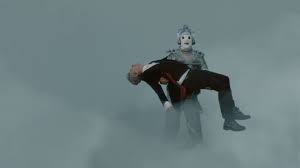
Although the appearance of two Masters is the episode's unique selling point, Bill remains at the heart of the story. Now transformed into a Cyberman, she struggles to reconcile her own conception of herself with the locals' mistrust of her appearance. This dissonance is expressed visually, with scenes focalised through Bill's perspective showing her as played by Pearl Mackie, while, in scenes seen from other points of view, she appears as a Cyberman.
The theme of a character clinging on to their identity, despite having been transformed into a monster, is one that runs throughout Moffat's writing for Doctor Who, including in Asylum of the Daleks and Death in Heaven. His exploration of this idea is, however, at its strongest in The Doctor Falls. Unlike Oswin's fate in Asylum of the Daleks, Bill's transformation is not treated as a plot point. Because the audience already knows what has happened to Bill, there is no mystery surrounding her fate. In this way, Moffat ensures that the audience's engagement with Bill is emotional, rather than intellectual. Her tenacity in clinging on to her sense of self and her bravery in the face of suffering are character traits to be admired, while her predicament also functions as an exploration of what it feels like to be othered.
While Bill's experiences in The Doctor Falls can be interpreted as a critique of racism, the response to her fate hasn't always been positive among all fans. During the COVID-19 lockdown, a planned watch-along of World Enough and Time and The Doctor Falls was cancelled, due to negative responses from fans who felt that revisiting Bill's death would be inappropriate, given the then-recent murder of George Floyd in Minneapolis and the ensuing Black Lives Matter protests. Although I would argue that Bill's experiences in the episode are underlined by a positive message --- that you should embrace who you are in spite of how people might see you --- it is totally understandable why the organisers decided to cancel the event. Moreover, the fact that the episode's creators failed to see the negative ways in which inflicting so much pain on a Black female character might be perceived highlights the limitations of having a primarily white creative team.
Nevertheless, despite all the suffering inflicted upon her, Bill does get to enjoy a happy ending. Bringing back Heather from The Pilot and having her resurrect Bill was a risky move, as it could have come across as purely deus ex machina. While this scene treads a fine line between the sublime and the ridiculous, it does, in my view, come out on the correct side. Like all the best endings, it feels surprising but also inevitable. The mystery of Bill's tears is integrated well enough into the plot for Heather's appearance to not feel as though it comes out of nowhere, while judicious use of flashbacks ensures that the audience are reminded enough of her character to not be completely bewildered. Although it is perhaps a little too similar to what happens to Clara at the end of Hell Bent, Bill's exit ultimately works. Her goodbye to the Doctor, who she has seen die but can't quite believe to be actually dead, is also touching, offering some much-needed hope amid the darkness.
Given how much else goes on in The Doctor Falls, it can be easy to overlook the event referred to in the episode's title. This is indeed the Twelfth Doctor's last stand, even if it isn't quite his final bow. Facing off against an army of Cybermen, despite knowing that the battle is unwinnable, the Doctor reaffirms his most basic values. He does things not because they are easy, or even because they work, but because they are right. In falling in defence of a remote rural community, rather than the Earth or the universe, the Doctor makes it clear that no one is too small for him to care about. He is not a mighty hero, fighting for glory; instead, he is a wanderer who will help whoever needs help, even if it kills him.
In contrast to the Doctor and Bill's tragedy-cheating fates, Nardole's exit is curiously low-key. Ordered by the Doctor, he agrees to stay behind to help the colonists. Nevertheless, this muted goodbye fits with his unusual presence in the series. Although he's been travelling with the Doctor for longer than Bill, he has remained something of an unknown: a comic character who nevertheless has a deep connection with the Doctor via River Song, a teller of tall tales with a mysterious past, a friend, but also something like an employee. Despite his relationship with the Doctor, he was never a companion in the traditional sense, so it makes sense for his exit to be understated rather than tragic or heroic.
The presence of Twice Upon a Time means that The Doctor Falls isn't quite the ending that it appears to be. As well as being the second part of the series finale, it is also the first part of the Christmas special, with the Doctor's last battlefield foreshadowing the desolation of Ypres. Nevertheless, it does act as a suitable conclusion to Series 10, concluding Missy's story, while also saying goodbye to Bill and Nardole.
The Twelfth Doctor's own exit may be delayed, but The Doctor Falls is still a story about endings --- and new beginnings. As with Clara, Bill may be dead, her cybernetic body crumpled in the battlefield mud, but, somewhere, far beyond the scope of Doctor Who's writers, her story continues. Sometimes, it's not only the Doctor who gets to regenerate.