THE DOCTOR WHO RATINGS GUIDE: BY FANS, FOR FANS
| Story No. |
334 |
|
| Production Code |
Series 14 special
|
| Dates |
December 9,
2023
|
With David Tennant, Ncuti Gatwa, Catherine Tate
Written by
Russell T Davies
Directed by
Chanya Button
Executive Producers: Russell T Davies, Julie Garner, Jane Tranter, Joel Collins, Phil Collinson
|
|
Synopsis: Humans are going insane over their opinions.
|
Reviews
The Gap Between Past and Future by Niall Jones
18/7/26
Doctor Who can never end. That's not to say that it will last forever, but to observe that there will never be a point at which it can permanently conclude in a narratively satisfying way. There may have been points which would have made good endings, had Doctor Who been cancelled for good, but they would always have been cutting the series short. The only points that could have conclusively ended the story of Doctor Who --- Ian and Barbara's departure in The Chase or, more likely, the First Doctor's death in The Tenth Planet --- occurred way back in the 1960s. With its myriad writers, producers and lead actors, Doctor Who is a story that belongs to no one. Likewise, it does not tell one story. In this respect, Doctor Who is more like a comic strip or a soap opera, in which a range of writers tell a loosely connected series of tales, than a TV drama, in which a single writer or group of writers tell a story with a clear beginning, middle and end.
Given this, it's slightly odd that the revived series of Doctor Who has so many finales, as they can never be truly final. A finale may provide an individual series with a conclusion, but its true role is Janus-like. It must be both an ending and a beginning, wrapping up an era of the show, while also allowing it to continue. Perhaps more than any other story in Doctor Who's recent history, The Giggle epitomises this ambiguity, standing between the show's past and its future.
On the one hand, The Giggle is dense with ghosts from Doctor Who's past. You have David Tennant's Doctor, Donna Noble, her family, Melanie Bush, Kate Lethbridge-Stewart and the Toymaker, but also references to Amy Pond, Clara Oswald, Bill Potts and the Flux; the Master, the Guardians, the Pandorica and even Mavic Chen. At the same time, The Giggle also introduces elements that will go on to play a central role in Series 14 and 15. There's UNIT HQ, Colonel Ibrahim and, most important of all, Ncuti Gatwa's Fifteenth Doctor. In its sixtieth anniversary year, Doctor Who looks both backwards to its past and forwards to its future.
The specifics linking Doctor Who's present to its past are worth looking at in more detail. In bringing back the Toymaker, Russell T Davies does not merely dig deep into the show's lore, but also reshapes it for his own purposes. While The Celestial Toymaker, which introduced the character in 1966, has long been regarded as a lost classic, its reputation has taken a battering in recent years, falling from eighth-best First Doctor story in Doctor Who Magazine's 1998 anniversary poll to a lowly 23rd in the 2023 iteration. There may be various reasons for this, but one crucial one is likely the acknowledgement that The Celestial Toymaker --- a story in which the villain dresses as a Chinese mandarin and which uses racial slurs both in its title and its dialogue --- is racist. Davies explicitly states this in the behind-the-scenes programme Doctor Who: Unleashed and addresses the issue onscreen by reflecting it through the Toymaker himself. Whereas the Toymaker of old was a passive reflection of the writers' prejudices, the new Toymaker is actively engaged with questions of stereotyping.
When we first meet the Toymaker, it is at a toyshop in Soho, 1925. He sounds German, which gives the scene an appropriately Brothers Grimm atmosphere, but his accent is over the top, almost comical --- he describes rain as 'the water all splishy splashy' and later pronounces Donna as 'Tonner'. The accent, however, slips and, for much of the rest of the episode, he speaks with Received Pronunciation. It becomes clear that 'German toymaker' is simply a role that he enjoys playing. Indeed, 'play' is the optimal word. The Toymaker is beyond good and evil, order and chaos: play is his only value. Identities are masks to be worn or discarded at will. For Davies, adding this dimension to the Toymaker not only explains his appearance in his debut story, but also shifts the racism away from his conception and onto his character --- it's no coincidence that he's casually racist in his opening scene.
Given the significance of the Toymaker's shifting accent, it's appropriate that he is played by magic-loving American actor Neil Patrick Harris. Harris gives a magnetic performance that is big and energetic, but which never topples over into parody. The Doctor is clearly scared of the Toymaker, and Harris's performance makes you feel that he is right to be afraid. The way in which the Toymaker combines manic glee and genuine threat also echoes the Master. In fact, echoes of the Master resound throughout the episode, most notably in the dance sequence, which recalls Last of the Time Lords. Here, the Toymaker infiltrates UNIT HQ whilst dancing to the Spice Girls. Simultaneously comical and disturbing --- two characters die by being turned into bouncy balls --- it acts as a key set piece and provides some of the episode's most memorable images: the rose petals firing from Kate's gun, the Toymaker making snow angels in them.
On the face of it, it seems an odd decision to bring back an obscure villain from a 57-year-old story that is three-quarters lost at such a critical moment in the show's history. The effect, however, is to give added significance to the original by elevating the Toymaker to mythical status. This may seem ironic, given Davies' criticisms, but it also shows that, when done carefully, reimagining Doctor Who's past can bring it new life. Given that no one has actually seen The Celestial Toymaker in its original form since it was broadcast, fan affection for its villain --- who was originally slated to return in the unmade 1986 story The Nightmare Fair --- seems to be based more on the idea of him than his reality. Therefore, retconning the character and making him the first member of the Pantheon that the Doctor encounters actively enhances the original by making him more in line with what fans may have always imagined.
While it is the return of the Toymaker that draws headlines, he isn't the only figure from the Doctor's past to return. The reappearance of Melanie Bush (who admittedly had a cameo role in The Power of the Doctor) is beautifully done and further shows the extent to which reimagining the past can actively enhance it. There's something very lovely about the low-key nature of her reintroduction --- the beat that it takes for the Doctor to recognise her, her easy friendship with Donna. It's fair to say that, during her time as companion to the Sixth and Seventh Doctors, Mel wasn't exactly well-loved. The Giggle, however, shows that she could have been a great companion. She may not be the centre of attention, but she certainly forms an effective and likeable part of UNIT's ensemble, able to put her musical knowledge and computer skills to good use. By taking a previously unloved character and revealing her potential, Davies shows that you can find as much gold revisiting Doctor Who's past failures as its successes.
The plot of The Giggle --- something I've so far spent over 1000 words not discussing --- centres around a sudden spike in human aggression, which the Doctor and UNIT quickly discover has its roots in a message hidden within all television broadcasts. This was placed there by the Toymaker via Stooky Bill, a ventriloquist's dummy used in inventor John Logie Baird's first tests for the medium. The story of Stooky Bill is, in fact, true and was discovered by Davies while researching his (in my view underrated) 2021 drama series Nolly. It's therefore apt that Logie Baird is played by the same actor, John Mackay, in both Nolly and The Giggle. What ultimately lights the fuse set by the Toymaker, however, is the launch of a satellite that provides humanity with 100% internet access.
Here, Davies takes aim at social media. As a result of the Toymaker's plan, 'everybody thinks they're right all the time'. Chaos ensues. The effects of this, although only briefly seen, are stark, straddling a line between comedy and tragedy. The Doctor's encounter with an angry non-motorist is bizarrely humorous, but Kate's demonstration of it is disturbing in its nastiness. Having removed her defences, she accuses Shirley Bingham, a wheelchair-using member of UNIT, last seen in The Star Beast, of faking her disability. This scene is uncomfortable to watch precisely because it echoes real-life prejudices, like an online comments section come to life. In fact, the critique of social media in The Giggle is effective precisely because it hews so closely to real life. As with Jamie Mathieson's critique of capitalism in Oxygen, it presents its target in a realistic way. The scale may be exaggerated, but the basic principle is presented accurately.
Social media is also presented as a distinctly human invention. It's another game for the Toymaker to play --- and a human flaw for the Doctor to criticise. Throughout the episode, Tennant plays the Doctor with a furious intensity. He's never not Doctor-ish, but he comes across as aloof and overbearing: humanity's overlord, as much as its saviour. This intensity, this sense of being above humanity, is not something that has its origins in The Giggle --- you see a glimpse of it in The Star Beast, during the Meep's trial --- but it is part of what marks out the Fourteenth Doctor from the Tenth Doctor he so closely resembles.
The question of why the resemblance is one that is difficult for the episode itself to answer, as the reasons for it are all behind-the-scenes ones. It's a combination of Gatwa's unavailability, Tennant's interest in returning to the role and Doctor Who being in an anniversary year. The episode, however, does manage to come up with a semi-plausible in-universe explanation for the old face's recurrence. Donna's the one who suggests it: the Doctor has been running for too long, wearing himself out. The return of an old face is a sign of exhaustion, his body's way of telling him to stop. It won't satisfy everyone, but I think it's better for the explanation to be driven by character, rather than plot. Tennant's return actually has little bearing on the plot; instead, its significance lies in the way that it informs the Doctor's relationship with Donna. A plot-driven explanation (A legacy of the Timeless Child? The curse of Sutekh?) would also risk sounding silly and would quickly fade into irrelevance.
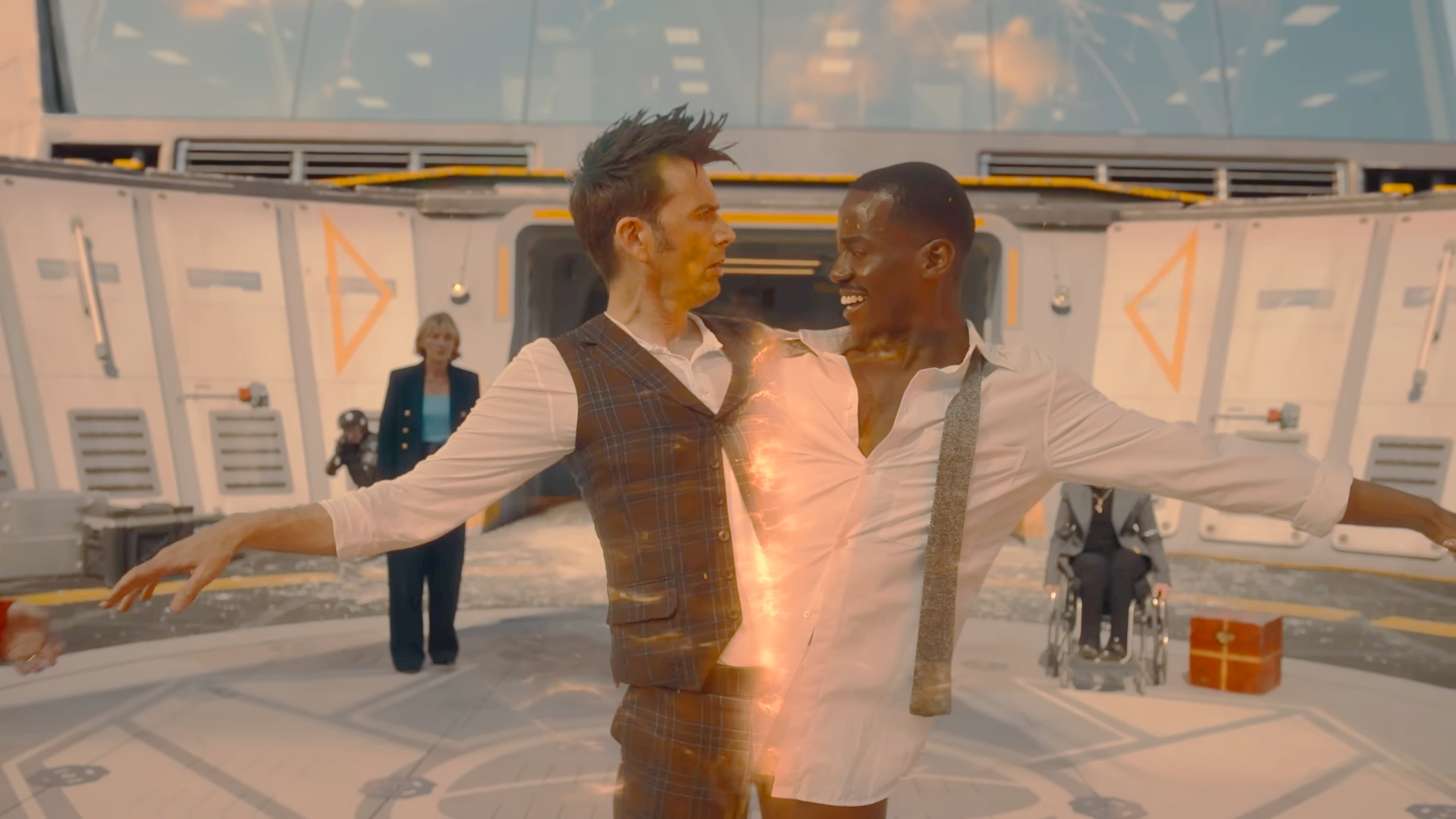
Given Donna's observations, it's appropriate that the Doctor ends the episode living with her and her family, despite his fatal encounter with a galvanic beam. The boldest part of The Giggle is the introduction of bigeneration. Instead of simply changing into his successor at the moment of death, the Doctor splits in two, with David Tennant's incarnation co-existing alongside Ncuti Gatwa's. This transforms the final part of the story into a multi-Doctor adventure, with the two Doctors working together to defeat the Toymaker. It also enables the Fourteenth Doctor to effectively retire, while the Fifteenth Doctor carries on his travels.
There are multiple ways to look at bigeneration. On the one hand, it opens up new possibilities and allows for more multi-Doctor stories; on the other hand, the continued existence of the old Doctor risks overshadowing the new one. Gatwa's performance at the end of The Giggle, however, is such that the idea of him being overshadowed feels laughable. His performance is energetic and charismatic; he's warm, emotional and camp; he even enters this world with no trousers on and nobody comments on it.
Having two Doctors co-exist at the same time sums up The Giggle's two-headed nature, reflecting on the past while also looking to the future. A lot happens --- the episode is stuffed with incidents, characters and references --- but a focused plot means that it doesn't feel bloated. It's not perfect --- Donna asking the Doctor if he comes in different colours is crass, while the Doctor's offer to the Toymaker to travel with him is a tiresome callback --- but it is still one of the strongest scripts of the RTD2 era, and Davies' critique of social media is sharp. Attempts to emulate its success in Series 14 and 15 will fall somewhat flat, but, as an individual story, The Giggle soars.