THE DOCTOR WHO RATINGS GUIDE: BY FANS, FOR FANS
| Episodes |
6 |
 |
| Story No# |
39 |
| Production Code |
OO |
| Season |
5 |
| Dates |
Nov. 11, 1967 -
Dec. 16, 1967 |
With Patrick Troughton, Frazier Hines, Deborah Watling.
Written by Brian Hayles. Script-edited by Peter Bryant.
Directed by Derek Martinus. Produced by Innes Lloyd.
|
|
Synopsis: Scientists battling a new Ice Age stumble upon
the Ice Warriors frozen in a glacier. The Doctor, Jamie, and
Victoria attempt to help, but the threat from the Ice Age and the
Ice Warriors may cause the end of civilization.
|
|
Note: The Ice Warriors Collection, complete with CD, is now available from BBC Video.
|
Reviews
A Review by Mark Parmerter
6/10/97
For fans unfamiliar with The Ice Warriors, the BBC release of this Season
Five adventure due in the Autumn of 1998 (to commemorate the 35th anniversary of
Doctor Who) should prove to be a welcome treat indeed! Continuing the
trends established during 1967 and 1968, The Ice Warriors boasts high
production values, solid scripting, well-developed characterisations, and an
abundance of creative ideas.
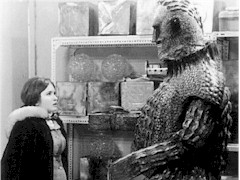
The Ice Warriors themselves make a stunning debut, literally towering over
the human cast and speaking in whispered yet frightening tones. Actor
Bernard Bresslaw, although thoroughly encased in smothering fiberglass,
effectively brings to the character of Varga (the Ice Warrior leader) a
vivid sense of identity and menace. Writer Brian Hayles is wise not to
focus his efforts entirely on the Ice Warriors, and as a result, characters
such as Leader Clent (Peter Barkworth) and Scientist Penley (Peter Sallis)
provide the story with the human element which it ultimately needs to succeed.
As usual, Patrick Troughton (the Second Doctor), Frazier Hines (Jamie), and
Deb Watling (Victoria) work brilliantly together, and their playful exit
from the Tardis in episode one is pure magic. Dudley Simpson's score is
suitably enhanced by the haunting vocal talents of singer Joanne Brown, and
Director Derek Martinus makes good use of scant resources in bringing to
life England trapped in the Second Ice Age. The Ice Warriors is loads of
fun, and its video release is long overdue. Also check out the terrific
novelisation by author Brian Hayles.
A Review of the Video Reconstruction by Matt Michael
13/11/98
The long-overdue video release of this story has been well worth the wait
judging by thr quality of the reconstruction that has been achieved.
Episodes 1, 4, 5 and 6 of this six part story were discovered in 1988 (in
the back of an old cupboard!). The missing second and third episodes are
covered by a fifteen minute linking section made up of telesnaps, audio
clips and narration.
The reconstruction is of exceedingly high quality. The picture and sound
quality has benefited enormously for having been digitally remastered,
making this perhaps the nicest sixties story to actually watch.
Likewise, the linking reconstruction is superb, far superior to Nick
Courtney's bridging narration on The
Invasion video release. Using essential parts of the soundtrack to
tell the story, with the aid of a number of very high quality telesnaps,
these two episodes are hardly missed (perhaps pointing to the rather slow
nature of sixties stories). And, for die hard fans, a CD with the
complete, digitally remastered audios of these episodes is included with
the video.
The story itself is nothing special (another Season 4/5 "base-under-siege"
installment), although it is made memorable by some superb performances
from both the regulars and the guest cast, and by the titular warriors
themselves. In fact, this is almost certainly the most successful Ice
Warrior story, and rates a 9/10 thanks to a nicely constructed
script and some good characterisation.
Also included in The Ice Warriors Collection is The Missing
Years, an impressive video documentary containing almost all the clips
from missing episodes, such as the "final end" of the Daleks (The Evil of the Daleks), the Doctor's first
regeneration and Troughton's first scene (The
Tenth Planet and The Power of the
Daleks) and some colour footage of the weed creature (). The tape concludes with The Underwater Menace Part 3, the
earliest surviving Troughton episode. Unfortunately, it does nothing to
disprove the critics who have called it the worst Troughton story. (I.e.
"Nothing in ze vorld can stop me now!")
Overall, a superb way in which to commemorate 35 years of Doctor
Who. perhaps we can hope for similar treatment for The Reign of Terror, The
Tenth Planet, The Moonbase and The Invasion in the future.
10/10
Worth Waiting For by Tom May
30/11/98
See also Tom's review of "The
Missing Years"
It was testament to the ancipation instilled in me by The Ice Warriors Collection that I purchased it during my lunch break on November 9, the
day it was released in the UK.
Firstly, the CD is of very clear sound, and very useful in order to
fully appreciate The Ice Warriors.
The booklet, while the least important part of the pack, does canonise
the Virgin NAs, which is admirable, and proves a reasonable read.
Plot-wise, The Ice Warriors is nothing special -- just another Troughton
"base under seige" epic. Where the story manages to excede this is in
it's stark, effective sets, singular music, and rich acting.
Peter Sallis and Peter Barkworth present an excellent pair of opposites.
Clent, the relatively benevolent, cold, conventional leader and Penley,
the idealistic drop-out from society.
As ever, Patrick Troughton is magnificent as the Doctor, providing the
only light relief of any sort in this grim tale. His great rapport with
Jamie and Victoria is brilliantly conveyed in their first scene, as is
the way the Doctor involves himself in the story. Victoria's horror at
the apparent death of Jamie is well portayed by Watling, although
Victoria's role is practically the same in every story by this stage in
season 5.
The loss of episodes 2 and 3 is overcame by a 15 minute linking
sequence, comprising very clear telesnaps and a top notch audio
soundtrack for the episodes. In other words, it's a mini telesnap
reconstruction.
The choice of material from the two episodes is generally good, and cuts
out some padding.
The voiceover, recorded by David Harley, is OK and doesn't detract at
all from the reconstruction.
Although I've not seen the links for The Invasion's missing
installments, it's definite that this approach is miles better.
The quality of the Ice Warriors as monsters is high, and they look as
imposing as any since the Cybermen. Everybody who brought them to life,
from Brian Hayles, to the designers and to the actors is highly
deserving of praise.
The undoubted success of The Ice Warriors as monsters, the sheer
presence of Pat Troughton and the success of the Penley and Clent
characters are the important factors which make The Ice Warriors stand
out as an individual, differing story in the brilliant yet hardly
eclectic Season 5. 8/10
They Came From Marsss... by Christopher Fare
9/1/99
This story is often acclaimed as very good, largely because of the
eponymous monsters and the fact that it is from Season 5. However, I
think it's only fair.
The good points about the story include the performances. The
entire human cast play their characters very well, with genuine
motivations and reactions. Special praise goes to Peter Barkworth as
Clent -- perhaps the only actor to outshine Patrick Troughton in the
series during his era. Points also to Angus Lennie as Storr, the
scavenger with a
mistrust of science. The scene where Storr is murdered by the very
creatures he
thought would help him is especially moving. Wendy Gifford is strong as
Miss Garrett,
but I can't really say much for the performance of Peter Sallis as
Penley -- it's strong and
well-judged, but I come away feeling he should have offered more.
Another point in the story's favour is the direction of Derek
Martinus, especially the
film sequences. The sequence where Victoria makes an ill-fated attempt
to escape
through a series of ice formations, pursued by an Ice Warrior, is
particularly
memorable. The design and direction of the whole story is very good
indeed.
However, there are problems. First and foremost, apart from the
Doctor, the other two regulars get very little to do. Jamie, in
particular, is unconscious or injured for
practically the entire story. Whereas in The Moonbase, this allowed Ben
and Polly to
step into the limelight again, here Victoria is no better off. A
captive for most of the
action, she spends most of her time hysterically yelling at the Ice
Warriors or just plain
screaming. Even the Doctor seems a little more "out of it" than usual,
although
thankfully nowhere near as much in the next story.
The other big error is the Ice Warriors themselves. Bernard
Bresslaw is impressive as Varga, giving him an identity and honour that
stands out in the mind. But his comrades seem faceless and
forgettable. Although the design of the creatures is well achieved,
they are far too slow to be truly menacing, and just don't have the same
presence as they do later with Alan Bennion around to lead them.
That said, The Ice Warriors is perhaps the closest we will ever get
to a Season 5 six-parter, and so we must be grateful for its existence. But I am
convinced that there
were better stories later in the season. That said, this story is
enjoyable, but perhaps a
little uninvolving for me to truly like it.
A Review by Stuart Gutteridge
1/8/01
The Ice Warriors is basically a base under siege tale; although
it does
have that extra something. The plot is helped greatly by the man versus
machine storyline, which gives it an extra thrust. Added to this are the
Ice Warriors themselves, imposing both vocally and physically and actually
quite intelligent. Great performances from the cast shouldn`t go unnoticed
either with Peter Barkworth as Clent and Peter Sallis as Penley deserving
special mention. Unfortunately the regulars aren`t given a great deal to
do. Victoria is captured, Jamie rescues her (as does The Doctor
eventually) but this doesn`t detract from the story as a whole.
Troughton, the unquestioned king by Mike Jenkins
12/11/01
Although some superb Mcoy or T. Baker stories (most notably D. Adams)
might
make me question weather the Troughton era is truly the greatest, it is
stories like these that make me come around again. While it really is a toss
up between these three great masters for me, Troughton always seems to come
out on top when all is said and done.
Despite the fact that the Mcoy era is
extremely underated and that Season Seventeen is the greatest one of all
thanks to Douglas Adams, Troughton gives the greatest portrayall of the
Doctor himself, despite any outside factors. This is one of the top five
greatest stories of the entire series and almost the greatest of
Troughton's
era, second only to The Web of Fear. It seems that
six parters worked better
for Troughton on the whole than for any other Doctor. The regulars are all
wonderful and the humans fear of the Ice Warriors allow them to take a back
seat which is a plus. Great stuff
Highly promising, but overlong by Tim Roll-Pickering
14/12/01
Based on the BBC Video and Joint Venture reconstructions of Two and
Three.
This is a story that starts well but gradually gets bogged down and
becomes tedious at times. It also suffers from several cliffhangers
which are resolved as though things happened differently, such as the
one at the end of [episode] Four where the Doctor is seemingly suffering
from the effects of the airlock, but at the start of [episode] Five he
quickly surrenders.
Design wise this story has much going for it such as the human costumes
which do look highly futuristic or Brittanicus Base itself which is
convincing as a preserved stately home turned into an emergency outpost.
The Martians' ship is highly functional and the Warriors' costumes are
impressive though only Varga and Zondal have well designed helmets with
the others' helmets looking somewhat comical. The scenes in the snow and
ice are also highly impressive, though the encounter with the bear looks
strongly like stock footage since the animal is never in the same shot
as anything else specific to the story.
Acting wise the story benefits from the strong guest cast, with both
Peter Barkworth (Clent) and Peter Sallis (Penley) providing strong
conflict and aa contrasting reaction to the difficulties of the
situation whilst Bernard Bresslaw makes Varga highly intimidating.
Indeed the use of both Sallis and Bresslaw shows that actors best known
for their comedy work (Bresslaw is best known as one of the Carry On...
regulars whilst Sallis has since found fame in the BBC sitcom Last of
the Summer Wine) can be cast in the series without degrading the story
in any way. However Angus Lennie (Storr) lets the side down somewhat,
being over the top. The regulars are strong as ever and get some
wonderful scenes, ranging from the Doctor's confrontations with Clent to
the scene where Jamie starts fantasizing about Victoria in one of the
extremely short dresses the female crew members wear, much to her
disgust.
What lets The Ice Warriors down is that the story has been
dragged out,
no doubt to ensure that as few stories as possible run to less than six
parts for budgetary reasons. Consequently a highly interesting tale of
Earth's future under threat from a natural disaster and the restoration
effort coming under threat from a discovery of an alien ship is let down
by the length of time taken to tell the story. What makes the story
especially interesting is that although it contains many of the
hallmarks of a 'base under siege' story, both Britannicus Base and the
Martians' ship are under siege from each other. The conflict between man
and computer is dragged out a little too far, with Clent and Miss Garret
at times treating the computer like an all-powerful deity.
Had The Ice Warriors only been a four part story it would
undoubtedly
come across as far stronger but at six parts it is clearly overlong.
7/10
The BBC reconstruction is the first ever professional reconstruction of
episodes and in terms of quality it is vastly superior to any fan
efforts due to the use of snow and flickering screen effects as well as
twisting the image to convey movement. However it is let down by the
fact it is only a shortened version of the episodes and the subsequent
reconstruction of Episode 4 of The Tenth Planet has
shown that a full
length reconstruction can work. As a summary it's hard to fault, other
than the bizarre scene at the start where a communicator announces that
a technical fault has occurred, but as a replacement for missing
episodes it cannot take the lead in the field. 7/10
The Joint Venture reconstruction is cruder due to the less
sophisticated
materials available, but it is complete. As with all JV recons it uses
text captions to cover unclear action scenes and so it is highly
watchable. As an added bonus the team have timed the reconstructions so
that it's possible to watch them whilst using the audio CD that came
with the set for sound. This strikes me as a good idea, but I am unable
to review its effectiveness as my CD player wasn't accessible whilst I
was watching the episodes. Rounding the whole thing off are
reconstructions of the trailers for both The Ice Warriors and The Enemy
of the World. This reconstruction is a wonderful complement to The
Ice
Warriors boxed set, not least because the tape also has the team's
reconstruction of The Underwater Menace on it as
well. 8/10
Arctic Ice, Green Warriors In Black & White by Matthew Kresal
5/8/18
Doctor Who's fifth season is an interesting one. Essentially one long series of "base under siege" stories, it was the season that gave the series many of its iconic monsters. Coming smack dab in the middle of it, and just before the monster-less The Enemy of the World, came The Ice Warriors. With the titular creatures still appearing in the series as recently as Peter Capaldi's final season, it's safe to say that they've become mainstays across TV and spin-off media. How does their debut story stand up after fifty-one years?
Thankfully, with the 2013 DVD release, we can watch the story again in full. With two of its six episodes long missing from the BBC archives, judging the story hasn't been an easy task, despite surviving audio and the stills reconstruction done in 1998. The 2013 DVD release offered up the two missing episodes as animations. The black-and-white stories suit animation rather well, especially given that Patrick Troughton's Second Doctor is well suited to the caricaturing animation requires. Unfortunately, the animation for The Ice Warriors is the weakest seen to date in the Classic Who DVD range, with characters feeling more like paper dolls with painted faces at times with odd limb movements (see Jamie being knocked out by an Ice Warrior moments into episode two). Despite that weakness, the animation completes the story and allows us a better idea of what the story was like before being wiped and junked by the BBC.
For starters, it has a solid premise. Brian Hayles' script contains a fair share of interesting ideas and themes brought nicely to life by the production team. The story, set at a base in Britain in a future time where ecological disaster threatens, is as solid premise in 2018 as it was in 1967. Even more so when one considers that the base under siege is run and populated by people using a technology that not only offers salvation but over-reliance. There's even Storr, a character that willfully denounces science as evil, despite the evidence around him of disaster (with intriguing consequences). These elements almost make this a story one thatis better suited for our time than the summer of 1967.
Where Hayles' script is very much of its time is in how it unfolds. Like virtually all of the stories from Classic Who's fifth season, it's six episodes long. Unlike, say, The Enemy of the World or Fury From The Deep, it also feels like it. There is an inordinate amount of wheel spinning going on throughout, with characters consulting computers, sojourns back and forth to the Ice Warriors' ship, and base commander Clent (Peter Barkworth) alternating between bravado and insecurity. Even watching the story an episode or two at a time (while keeping in mind viewers saw one episode a week in 1967), one can't escape the sometimes-thin plotting by Hayles.
Thankfully, the story has other things going for it, such as the titular creatures from Mars. Watching the story, it isn't hard to see why the Ice Warriors have remained as popular as they have. From the moment the warrior Varga comes out of the ice, they have an immediate presence. Towering over the rest of the cast and armed with thin but hissing voices, they exude menace and strength. Even if they have Lego hands and stomp along, that doesn't diminish their presence. Indeed, they help keep interest in a sometimes-flagging plot, which makes them all the more memorable.
The story also benefits from its performers. The casting is solid from the TARDIS crew down, with Troughton's Doctor getting to shine from the moment he climbs out of the TARDIS to various confrontations and conversations. Though the story sidelines Frazer Hines' Jamie in its back half, the upshot is an increased role for Deborah Watling as Victoria, although she is reduced once more to sobbing and screaming at times. The supporting cast is strong as well, with Peter Barkworth's leader Clent, Wendy Gifford as his willing aide Miss Garrett, and Peter Sallis as the brilliant but disaffected scientist Penley being particular highlights. They bring Hayles' script to life nicely, breathing life into sometimes-thin characterizations.
The story also benefits from being a solid production. The design work of Jeremy Davies creates settings ranging from a Victorian house overrun with (by 1960s standards) futuristic technology to icy wastelands and a Martian spaceship. While the technology may look dated, the sets do not, creating a believable setting for the story. Dudley Simpson's score is full moments of menace and intrigue, creating one of his most memorable scores in the process. With director Derek Martinus at the helm, the story is elevated as a result, though it never overcomes the flaws in its pacing or plotting.
That last sentence is as good a description of the story as I can present. The Ice Warriors has plenty of good things to say for it, the introduction of the Martians being amongst them. Ultimately, despite its strengths, it can't overcome the need to stretch things out that harms a fair few of Classic Who's longer stories. It's a solid story, but it could have been a great one.
A Review by Paul Williams
25/9/21
The Ice Warriors continues a run of strong Doctor Who stories, being the third consecutive tale to use the base-under-siege theme. The threat of the glaciers and the aliens is pitted against the humans and their logical computer. It combines a number of contemporary themes: environmentalism, the reliance on artificial intelligence, the subversive lifestyle and homosexuality.
In Clent, we find a flawed hero, trying to reconcile his human feelings with his responsibilities as leader. Several dialogue gems hint at undeveloped relationships between characters. Jamie's suggestion that Victoria consider a shorter dress is the most amusing. Whilst the two companions do not contribute much, the Doctor is in his element sparring with Clent and finding a worthy opponent in Varga.
Man vs. Machine vs. Monster by Jason A. Miller
29/9/25
The Ice Warriors is a story that should have provided grand visual spectacle: enormous Martians lumbering around a glacier; human scientists using the Ioniser trying to stave off the Second Great Ice Age. Director Derek Martinus had brought grand visual spectacle to his previous Doctor Who work, too.
But just try fitting all that spectacle into Lime Grove Studio D on a 1967-sized budget. So, instead, as soon as Varga wakes up from his millennia-old slumber at the Episode 1 (or "ONE", as they call it for this serial only) cliffhanger, he immediately spends almost all of TWO talking to Victoria at length. In two different rooms. For all that the Ioniser is meant to be mankind's last, best hope at saving five thousand years of recorded human civilization from the glaciers... we never even see it. Martinus had to mount a scientific base (charmingly disguised in a Georgian mansion), a plant museum, a glacier, tunnels and a Martian spaceship, all in a tiny studio. There wasn't room for all that and an ioniser too.
What The Ice Warriors becomes, mostly, is a succession of talky scenes, typically two (and sometimes three) characters debating points of order. However, unexpectedly, this all works gloriously. Because, and unlike the previous serial, the disappointingly shallow The Abominable Snowmen, The Ice Warriors is all about themes and conflicts. Man versus nature (the glacier). Man versus machine (the temperamental ioniser). Man versus monster (the Ice Warriors). And man versus man (Clent against Penley, the Doctor against Brittanicus Base's overly rigid personnel policies, and Storr against... well, everybody). Every lengthy dialogue scene has a purpose, every character has something interesting going on beneath the surface, even the rebellious scientist Arden, who exits the script far too early.
Writer Brian Hayles examines what it's like to be a man in a highly technological, ordered society. Penley, the brilliant computer programmer, has opted out of the glacier fight and lives in a plant museum with Storr, in what is coded as Doctor Who's first same-sex relationship. Clent walks with a limp and a cane and literally has to take time out in Episode 1 for massage-chair therapy to break an anxiety attack; his disability is a mere fact, incidental to the story and treated quite maturely. Penley and Clent have vastly differing views of how Brittanicus Base ought to be run, and the dialogue exchanges that take up the bulk of each episode portray those differences quite well.
And there's the Doctor as the wild card. The Doctor enters the base partway through ONE and saves the Ioniser from a catastrophic explosion. He's immediately drafted by Clent to replace Penley on staff... and then for most of the rest of the episodes, much time is given over trying to get the Doctor, the anarchic Second Doctor, the mercurial Patrick Troughton, to adhere to base protocol. "You don't get rid of my sort all that easily," Penley tells Miss Garrett; "Machines corrode and rust, but mankind goes on." And the Doctor, rebelling against one HR policy after another, tells Clent: "Your regulations do not apply to me. I work in my own way. Freely." This is all crackling dialogue, fierce and poetic.
And, fortunately, it's not enough for Martinus to have characters stand around exchanging meaningful words. He still manages to stage an impressive looking, fast-cut avalanche, in ONE, aided by some nifty Peter Diamond stuntwork. And the TARDIS crew's chemistry... oh, my heart! Troughton and Frazer Hines and Deborah Watling are in perfect sync, the most finely tuned companion team we've had, ever, clowning around trying to climb out of a supine TARDIS or popping their head around a wall: one, two, three. As Troughton chases Clent around the circular control room in Episode 1, his fur coat-tails flapping behind him, you as a viewer are given new life watching Troughton dominate the screen with his physical presence and agility, without even saying a word.
Speaking of physical presence, Bernard Bresslaw, best known as a comic figure in the movies, is stunningly good as Varga, the lead Ice Warrior. It's a strong performance, physically imposing, fun for kids to imitate on the playground with his sibiliant whisper and displays a variety of moods: hostility, patience, empathy, sardonic amusement, boredom, rage. The other Ice Warriors, save Zondal, are just names in the credits, but, as a group, this is an intimidating group of monsters.
With the script full of Lime Grove D dialogue-only padding scenes and with the need to keep the Doctor and the Ice Warriors apart until the end of the story, the Doctor and Varga don't properly meet until the FOUR cliffhanger. Martinus stages the heck out of this confrontation. The meeting is done entirely by video screen: Martinus has lots of characters communicate by video, with Arden and the Doctor in particularly spending much of the story talking out from monitors. This confrontation begins with the Doctor threatening Varga with a ten-second countdown and ends, at the cliffhanger, with Varga imposing a deadlier version of that same ten-second countdown. Great writing, great direction (Martinus used a similar cliffhanger in Galaxy 4) and, needless to say, great acting out of Bresslaw and Troughton.
Something else The Ice Warriors does well is death. Every death in this story is calculated to have maximum impact, horror-movie style. Davis dies in the excellent ONE avalanche. Arden is killed just after talking about a moment of great scientific discovery, with (at least, in the THREE animation) the Ice Warriors lurking up on him from behind. Poor old Storr --- previously a delight in his relationship with Penley, and then clowning around with Jamie as they both realize that they're Scotsmen and Loyalists --- is gunned down callously by the Ice Warriors after he volunteers to help them. Even the non-deaths are good; Jamie being shot in THREE has lasting repercussions, as he remains paralyzed for most of the rest of the serial, a will-he-recover tension the Classic Series rarely put on its companions.
The final episode is unimpressive at first blush but, when you look under the surface, is pretty incredible. It's another talky episode, mostly with debates about man-versus-machine and the dangers of using the Ioniser on the glacier containing the Ice Warriors' nuclear-powered ship. But Walter's death is an effective nervous breakdown, another meaningful death. The sonic cannon goes off twice, with devastating results. The destruction of the Ice Warriors' ship is another furious bit of Martinus business: flames, smoke and special camera effects, and the picture literally spins out of the frame at the end.
Most Doctor Who stories have monsters, but few of those monsters go on to have 50-plus year lifespans. Season 5 alone features Cybermen, the Great Intelligence and the Ice Warriors. We are in the middle of a special run of stories; The Ice Warriors certainly has its limitations, but it's strongly above average and another big success in the Troughton Era. That's the magic of Doctor Who; great drama can be staged in Lime Grove D on a micro budget, and here we are still talking about it 55+ years on.