
Jubilee
Jubilee

|
Jubilee |
Big Finish Jubilee |
|
| Author | Rob Shearman | 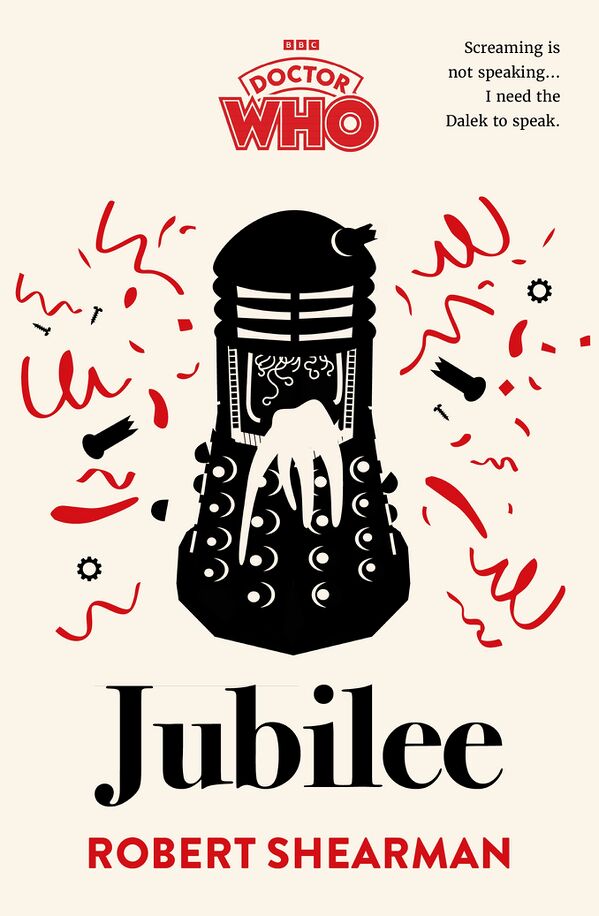 |
| Published | 2025 | |
| ISBN | 1 785594 957 9 |
| Synopsis: It is time to celebrate! Let all the citizens of the glorious English Empire come together and give thanks to that mysterious soldier in time and space known only as the Doctor. For 100 years ago he destroyed a Dalek invasion force without mercy, and became the saviour of us all. We have just one real Dalek left. Kept alive in the Tower of London, all these years our prisoner. And tomorrow we are going to blow it up, just for you! So put up your Dalek bunting and raise a glass of Dalek Juice. Who knows, there may be a special guest in attendance: the Doctor himself! Oh, you lucky people! |
A Jubilee of Prose by Matthew Kresal 11/10/26
There was a time when there was no Doctor Who on television. During what's come to be known as the Wilderness Years, Doctor Who lived on via novels and audio dramas. It was as part of the latter that saw the release of Jubilee in 2003, heralding in the series 40th anniversary with a script by Robert Shearman featuring Colin Baker's Doctor and Maggie Stables as Evelyn Smythe. A story that was so strong that, when the Doctor came back to TV two years later, it became the foundation upon which the series best-known villain received their 21st century screen debut. More than two decades later (and four years on from that TV episode itself being novelized), Shearman has revisited Jubilee as a novel to produce a curious piece of Doctor Who fiction.
Curious in part because it's the first novelization of an audio story since, what?, The Ghosts of N-Space thirty years earlier? As that might suggest, the track record for such novelizations isn't exactly a winning one. Victor Pemberton spent years promising he could deliver a first-rate novelization of The Pescatons, only to deliver a subpar and padded expansion of a 45 minute audio drama. Eric Saward tried to pastiche Douglas Adams with both the radio and prose versions of Slipback to less than stellar results. Then, in the 1990s, Barry Letts offered hit and miss adaptations of both The Paradise of Death and the aforementioned Ghosts of N-Space that tended more towards the latter than the former. Perhaps it's no wonder that it's taken this long (and having a writer of Shearman's caliber) before any of Big Finish's prodigious output has made it to the page.
And the results? Superb.
It no doubt helps that Shearman's original script for Jubilee stands head and shoulders over any of the above (though The Paradise of Death's radio version worked as Letts doing an early nineties update of the Pertwee era). All of its strengths are preserved here: the Doctor and Evelyn, a dystopian Britain built on defeating the Daleks a century earlier with a lone Dalek in the Tower of London, and a temporal paradox at its heart. 2003 Shearman's darkly comic sensibilities remain intact here, as well, as demonstrated by the Rochesters with husband Nigel as the mad leader of a notionally republician British empire and his wife Mariam. If you're a Big Finish listener, particularly of the Sixth Doctor and Evelyn audios, there's also a certain thrill in reading the two of them on the page together, doubly so in getting to have Evelyn spending time on her own coming to terms with this alternate version of what is her own recent past. So much of what made Jubilee the instant classic it became have made it to the page, and Shearman has even restored some moments cut from the original owing to time constraints.
But the blurb promised "a brand new, radical reinterpretation" of the audio. From the opening pages, it's clear that this isn't quite the same Jubilee that listeners have been enjoying since early 2003, given that the opening scene of the audio doesn't appear until the second chapter. The opening episode is essentially re-sequenced as a result, but it also shows that Shearman wasn't going to play it safe. This isn't going to be a cut and paste, "x said" with the odd bit of description style of novelization.
Shearman breaks the curse of audio noveliations that doomed Pemberton, Saward and Letts by understanding that, like his novelization of Dalek, this version of Jubilee needed to be built to stand on a new foundation. Not to mention doing so in an entirely new medium. Sometimes to work better in prose (such as the actual jubilee "celebration" late in the narrative where Shearman is able to better explain exactly how the paradox comes together at a crucial moment), but also to take advantage of what prose can offer. As well-realized as the lone Dalek was on audio, the portions where Shearman takes readers inside the casing to explore its captivity and what drives it towards its end are among the best pieces of Doctor Who prose you're ever likely to come across. Shearman's vision of a dystopian imperial Britain likewise builds not only upon the original script but how the world has gone since it was written, exploring both the power of nostalgia as a political force and the dangers of ignoring or making light of the darker chapters of history. Not to mention how Shearman takes the darkly comedic "Daleks do not sing!" scene from the original audio and rebuilds it to an even more devastating conclusion, all the while making a meta reference about the Dalek operators on-screen. The results are familiar but revelatory, illuminating the original audio but allowing this to be a standalone read.
It's also something that makes this version of Jubilee more than a belated artifact of the Wilderness Years. Even if you've heard Jubilee more times than you can count or care to remember, there's something in Shearman's prose here to make this a worthwhile read as a piece of fiction in its own right. Or, in other words, a first-rate novelization and an excellent read to boot.