
Muse of Fire

|
|
Big Finish Productions Muse of Fire |
|
| Written by | Paul Magrs | 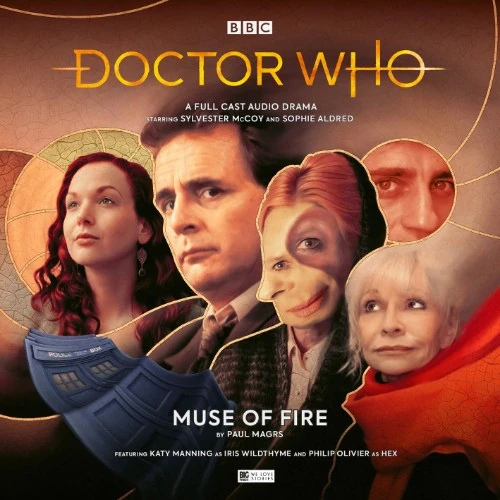 |
| Format | Compact Disc | |
| Released | 2018 |
| Starring Sylvester McCoy and Sophie Aldred |
| Synopsis: Oooh la la! It's been a long time coming, but the Doctor is about to be reunited with Iris Wildthyme! They're both in 1920s Paris, and everyone's flocking to Iris's salon. But wait...! What's that noise..? Thud thud thud...! It's the soft, approaching feet of a small and acerbic Art Critic Panda...! |
Needs a new Muse by Thomas Tiley 24/8/25
Landing in Paris during 1920s the Doctor, Ace and Hex expect to be greeted by a collection of Earth's finest minds --- artists, writers, poets --- but instead find the city to be devoid of genius, the intelligesta driven away by the fierce critical mauling of a literary critic. Meanwhile, a failed American poet prepares to leave Paris and is suddenly struck with inspiration after an encounter with the strange, veiled Dora Muse. He's inducted into the Salon of Paris latest patron of the Arts, an old flame of the Doctor's, Iris Wildthyme. Are the two events connected?
First of all, it's lovely to hear Philip Oliver as Hex again. Muse of Fire is set early in his travels according to the extras and it's fun to see (or rather hear) this TARDIS team again. The teasing between him and Ace gets a little irritating but other than that, no complaints. McCoy is in fine form, giving a good performance, save a few weak moments when he has to be angry; in addition, the play's author appears to be taking the piss, giving the actor who famously rolls his r's allot of alliterated lines beginning with r at one point.
Katy Manning gives her usual performance as Iris Wildthyme, all 'Loves, Chucks, Ducks and Call me Auntie Iris' and all those affected mannerisms, which even the characters in the play call her out on for being annoying. I must admit to once finding her character interesting at least in prose form but in the audio flesh, so to speak, she is rather hit or miss. If only they would tone her down a touch (although I understand she is meant to be a larger-than-life, take-her-or-leave-her sort of person, a marmite character). Her meta characteristics, of which she is so well known by (being essential a female version of the Doctor, claiming his adventures as her own, commenting on the cliches of Doctor Who) are wisely toned down for this story. Meta-type characters, humor and commenting on the tropes and cliches of fiction are more overdone these days than in the 90s where she originated from.
Also, I have issues with the way Iris is treated. She talks about how the Doctor has changed and how wounded and hurt she is at his false accusations and not being trusted by him and how he has changed for the worst. However, she started originally as a comedic sort of Female Doctor analogue in the books/audios, so giving her a quasi-dramatic emotional moment is odd. She is such a caricature of a boozy northern auntie so it's hard to take her being sensitive and emotive seriously, like expecting us to take the tears from a clown seriously.
Rebecca La Chance and Gethin Anthony as the American couple are okay, forming a sort of RTD-type emotional subplot about their marriage and his failed attempt at making it in the Paris art circle. His Dada-esque poetry readings are alright too. Panda (David Benson) is amusing also, the image of a stuffed teddy bear typing harsh literary criticism on a typewriter is something I will never forget. His banter with Ace at gunpoint is funny, her mocking him for not being able to reach the doorknob and him snapping back.
Christine Kavanagh as the villain Dora Muse is all right, looking like an expressionist painting without her veil. She has an interesting accent but is too obviously the villain, which makes the Doctor falling for her lies look out of place and stupid. I had expected it to be a double bluff, with the Doctor just pretending, but the story plays it straight.
There are a few good snaps of French-style music at some points, but otherwise the story falls flat musicwise, the music seemingly forgotten after the first episode.
The title is odd, I know the author likes to use film titles for his stories (The Scarlet Empress, The Blue Angel) but who is the Muse of Fire? Yes Dora Muse might count as a muse when she inspires/brainwashes the poet to babble out his odd poetry, but the only fire in the story is the weird flame map she keeps in her shop, so it's a rather weak link to make.
Paul Magrs writes for the seventh Doctor, something anyone who has read The Scarlet Empress and his comments relating to this incarnation will be alarmed by or at least take attention. Seven really doesn't come out of this story looking great, as expected, essentially miscalculating and messing up, leading Iris to save the day. There is some stupid repetition: Hex comments about a glowing map of flame not being from this planet twice in the space of three minutes (three times if you include the cliffhanger recap). The stair sequence in part one is also annoying (we are informed they are approaching the steps, hear them on the steps and then hear the fall, then it's said out loud that he has fallen even though its is painfully obvious what has happened; later the characters have to point out that the balcony has a long drop into the river, repeating obvious stuff). It's predictable (we know who the villain is within moments, and when Iris asks Hex to come to her art class you just know he will end up posing nude for it, the only surprise being that Ace and the Doctor only walk in on the class after it is finished and he is covered up), misuses the setting (Paris in the '20s was filled with lots of interesting people that the author could have used and the plot has them all out of town; Salvador Dali is only in it for five minutes, but you could have had a whole story about him) and it completely botches up the seventh Doctor.
This is one of those stories where if the two parties involved sat down and spoke/listened to each other for five minutes, then everything would be resolved. Instead, they talk over each other, don't explain and generally act out of character. I know the story would be over by part three in that case, but a good writer would be able to think of something and Magrs works for a university, so he can't be that dull. Instead of Seven thinking Iris has turned to the dark side, he should have asked her what she was doing, and instead of Iris acting all wounded at Seven's accusations, she could have simply said (spoiler alert) 'I am on a mission from Alien Royalty to stop a Brain Vampire feeding on Earth's geniuses, which is why I had Panda write all the bad reviews to send them out of town.' Now Seven could have been written as trying to plot and scheme and have to modify his plans on the go as in several of his television stories, or he could have even been written as having his plan backfire or been foiled, but instead he is written as someone who falls for the baddy's lies, believes everything he is told and turns against Iris (who if we remember has been his friend for several incarnations now). Then his plan unwittily ends up serving up the baddy with all the geniuses she needs. It comes across as the author simply disliking the character and not writing him properly. Fair enough if you don't like him; don't write for him, it's easy, I would never write a War Doctor story or a Jack Harkness story for that reason. However, if you have to write for a character you don't like, at least try to do him justice.
The ending enters a weird cul de sac in which the momentum of the plot just stops. Instead of climax, explanation, conclusion/wrapup, we get climax, conclusion/wrapup then an explanation and then it ends. Spoilers, but basically Iris, the poet and Panda go over the balcony in order to defeat Dora Muse, the TARDIS gang hang around for a while waiting for her to turn up, notice her bus is missing then leave. Okay you think, a perfect way to end the story in a sort of air of hope/mystery (Iris and co are obviously still alive and got away) but then we enter a plot languor in which Panda is mourning her and then Iris turns up to pick him up whereas the plot sort of judders to a halt for Iris to explain in detail how she escaped her dip in the Seine (she summoned her bus) before the story ends. Now had Ace or Hex or the Doctor gone into the river, then we would have wanted an explanation for how they survived, but for Iris? We don't need this explanation. She is a comedic meta-joke character; she survives because that's what the Doctor would do, and the details of how she survives are irrelevant. It certainly doesn't need to be over-explained a minute before the story ends.
The story and execution are all right, average. It should have been a five but minus a point for Magrs' contempt of the Seventh Doctor, it's a four out of ten for me. If you like Iris or dislike her add or subtract a point as you please.