THE DOCTOR WHO RATINGS GUIDE: BY FANS, FOR FANS

|
BBC
The Robot Revolution
|

|
| Story No. |
345 |
|
| Production Code |
Series 15 Episode 1
|
| Dates |
Apr 12,
2025
|
With Ncuti Gatwa, Varada Sethu
Written by
Russell T Davies
Directed by
Peter Hoar
Executive Producers: Russell T Davies, Julie Garner, Jane Tranter, Joel Collins, Phil Collinson
|
|
Synopsis:
Belinda Chandra is kidnapped and taken to a planet named after her by her ex-boyfriend.
|
Reviews
The Incel Revolution by Stacey Smith?
16/11/25
Ncuti Gatwa and Russell T Davies are back for a second season, which gets off to a flashy start. There are colourful emoji robots, CGI battles, timey-wimey shenanigans, a new companion and some intriguing hints for the rest of the season. There's money on the screen, jokes, witty wordplay and a funny robot. (I love a funny robot!) It's pretty much a standard season opener.
Except it's not.
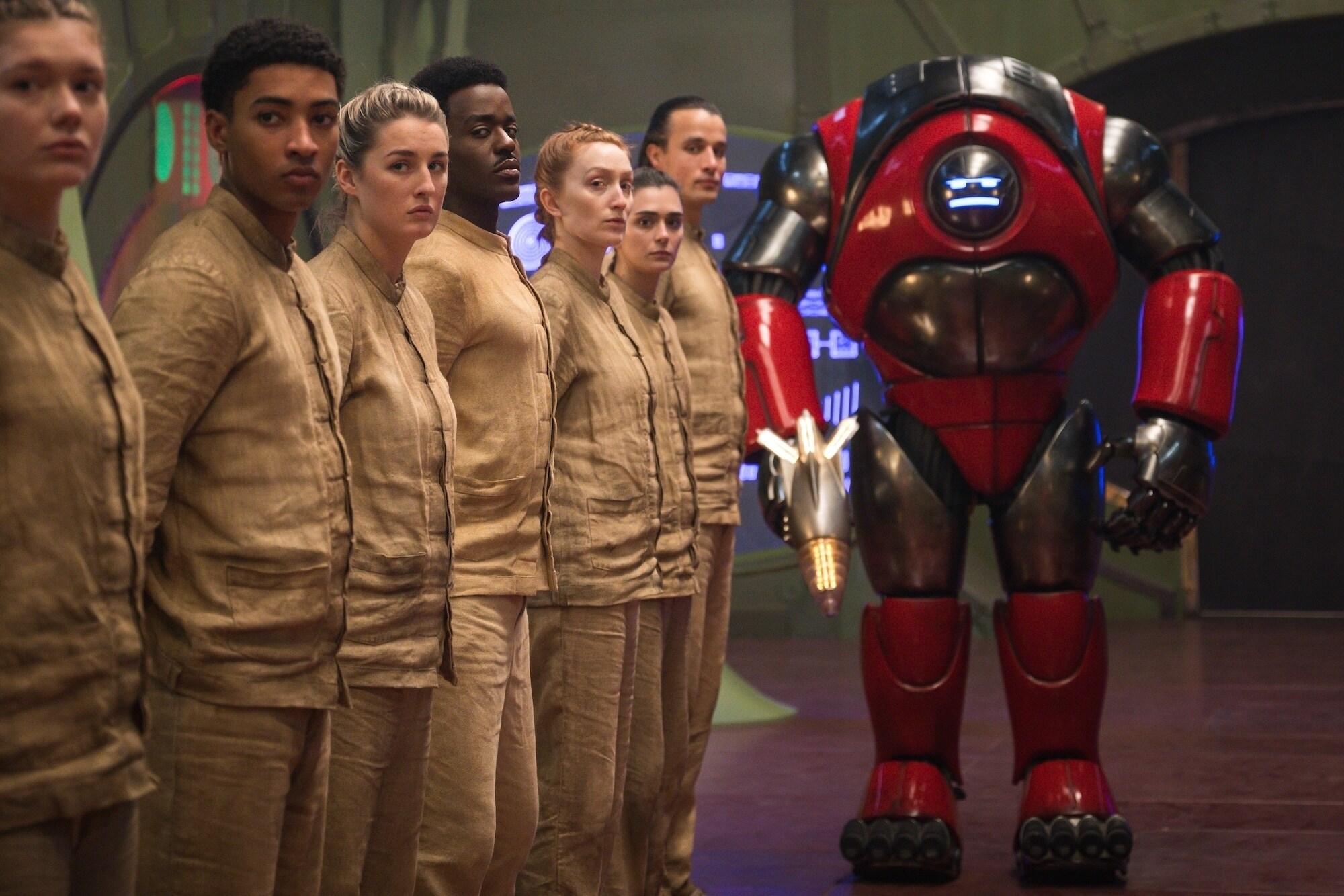
The Robot Revolution is doing something very, very clever. Well, several somethings. First, it's brilliantly setting expectations for what kind of story this is... and then subverting those expectations magnificently. It looks exactly like a whizz-bang season opener, something like The Star Beast, with lots of action and colour and fun for the kids, with cool weapon effects and a flashback to Boom. Second, there's the bait-and-switch that is Belinda Chandra. The new companion is introduced elegantly, with the conceit of the star certificate being very amusing indeed. Belinda is a nurse, which seems like exactly the sort of caring profession that every New Who companion falls into.
Except it's not.
Belinda is a nurse, sure, but not because she's compassionate and kind but rather because that's a perfect shorthand for someone who's exhausted by all this crap. The hospital montage in 2025 exactly mirrors her actions on the planet in the middle of a warzone. She slips into exhausted care while the roof is falling down because that's always been her life, at least since COVID. The Doctor tries to make the connection that the Doctor and the nurse make a good team, but she rightly points out that this is too twee a reading of the situation, because doctors tend to stand back while nurses do all the hard work.
That's basically what happens with Sasha 55, who is retroactively set up as a new companion, only to be killed off before the episode really gets going. She's friendly and likeable and has a backstory with the Doctor, who had promised to take her to the stars. She seems like a standard decoy, there to show why Belinda is companion material a la Julia in Smith and Jones, who was there only to show us how much more suitable Martha was.
Except it not.
What's happening with Sasha 55 is much more similar to what happened in Joy to the World: the Doctor is grooming multiple companions, many of whom are killed along the way. This makes some sense, because his world is dangerous, but it's a creepy take on the Doctor's methods, one that plays into the larger incel theme. Sasha is given a depth that belies her short screentime, including a slo-mo death scene and a memorial at the end, clearly indicating that she's not just another NPC. This is part of the time-travel shenanigans, which fill in multiple backstories of the planet, but the real point of this is to allow the Doctor retroactive time to become established on MissBelindaChandra, which gives him community, a pseudo-companion and an investment in the planet's outcome.
Belinda is a different sort of companion altogether, not buying into the Doctor's BS. She isn't all sweetness and light, either in tone or actions. It's telling that she's presented as so much older and tired than the exuberant version she portrays in the cold open, which is a fascinating way to present the new companion. She refuses to be shushed and fights her own battles, not letting the Doctor do it for her. She (hilariously) confronts him with "Am I six?" when he uses the words "timey-wimey". And she only starts taking the Doctor seriously when he says, "If you start deciding which body is best, you're going down a very dangerous path."
Tellingly, she asks before fixing the injured man's shoulder and before listening to the Doctor's hearts. However, she also reactivates the polish robot in order to surrender, a controversial move that did have a decent outcome but so easily might not have if the robots had swarmed the place and shot everyone on sight. However, her agreeing to marry the AI Generator and essentially sacrifice herself in the name of peace is a generous move. That's the kind of companion I want to root for.
It's around this point that things start to serious subvert.
The discovery that the cartoony robot revolution was in fact the product of incel thinking is such sharp commentary it could draw blood. Alan appears to be a typical "nice guy" in his opening interaction with Belinda... but there's a dark heart lurking beneath, and he quickly takes to power and control as soon as he's given the chance. The fact that this is viewed through the lens of video games is what makes this commentary sing, because that's key incel behaviour; he's even shown playing a video game when the robots storm his basement. On the planet, he controls everything, but he's literally half a man. It's no coincidence that all the promises he makes sound exactly like the Cybermen. And in the end, he's reduced to the moment of conception: the concepts of a man.
What does an incel fundamentally do? He uses surface niceness to disguise control issues and takes liberties as soon as he's able, just because he can. He makes grand pronouncements about destiny and connections that are meant to be. He believes he's fundamentally entitled to women's bodies and to power. The pretty much describes Alan to a T... but it also describes the Doctor.
This is where The Robot Revolution really shines. That final TARDIS scene is breathtaking in its audacity: it posits that what the Doctor does is scarily similar to incel behaviour. The Doctor is all charm and niceness on the surface --- witness his practising his smile through the tears after Sasha 55 was killed --- but he's also entitled and will take liberties without asking, such as scanning Belinda's DNA without her consent. This is a stunning take on the Doctor, one that's uncomfortable and edgy... but it's not wrong, either. "I can't help thinking that maybe we are meant to be connected" is the sort of line that would give any woman the shivers, and that's no less true for the Doctor uttering it, even as a gay-coded man.
The Doctor has always used exterior charm to disguise what's really happening underneath. Previous Doctors have secretly scanned Amy for pregnancy or Clara for impossible-girlness without their knowledge, and those actions were never questioned. Here, Belinda the nurse calls the Doctor out on this behaviour because she's seen exactly this sort of thing in so many men. The Doctor tries to cover it by laughing, but his laughter gets increasingly strained. (Ncuti Gatwa is stunning in this scene, the discomfort behind the increasingly strained laughter showing in his eyes.)
We've seen previous stories put the Doctor on par with the villain, but it's usually been for some exterior reason and easily debunked. Here, it's a lot more difficult, and the Doctor's initial attempts to apologise are rightly rebuked, because he's not doing it seriously. He attempts to overwhelm her with charm and awe, but he eventually drops the facade. Only when the Doctor truly relents and actually promises to take Belinda home is he redeemed.
Just as Belinda rails against the situation being her fault, only receiving grace from Manny when she admits that it actually is, the Doctor does exactly the same in the TARDIS. When he admits fault, he rightly describes his actions as inexcusable, not offering an explanation, because this isn't the time. It's a stunning juxtaposition.
The Doctor is eventually redeemed because although he does the same things the incel does, he also does something different: he (ultimately) listens, apologises and then makes amends. It's easy to make mistakes, but the real measure of character is what we do afterwards. The incel fundamentally believes in his own entitlement, whereas the Doctor is willing to see the situation and his actions for what they are and to make up for it --- in ways that are genuine, not simply to get what he wants. That's the kind of hero I want to root for.
The Robot Revolution looks like one thing but turns out to be something very different. On the surface, it's a flashy high-budget traditional Doctor Who story of rebels and robots, time travel and caring companions. But beneath this "nice" exterior lies something darker and more painful. It's a story of male entitlement and grooming and the abuse of power in ways that are painfully close to home. And yet, it also shows how we can make amends for mistakes in ways that are real and honest, if we're willing to check our egos at the door. That's the kind of TV show I want to root for.