|
Roz Forrester |
Doctor Who is for everybody by Stacey Smith? 18/10/25
Steven Moffat once made the point that Doctor Who can't be a TV show made just for the liberal left. It has to appeal to everyone, from the apolitical (e.g., children) to the readers of the Daily Mail. It's a point he's made several times, claiming that the brilliance of Doctor Who is that it's a TV show that absolutely everybody can enjoy. As an unabashed liberal vegan trans lefty myself, I agree with him entirely.
Not just because I think Doctor Who is the best thing on television and hence everyone should watch it (although I do happen to think that). And not even from a "we need to convert right-wingers to our ways" perspective, although it is true that Doctor Who is a pretty left-wing show most of the time. There's also no harm in being exposed to ideas from all ends of the spectrum and bringing people together, rather than everybody living in their own bubble.
Moffat's stance makes perfect business sense. We in fandom forget about the other 5,500,000 viewers who watch Doctor Who every week but aren't hardcore fans. If you were the producer of a high-budget, populist TV show for the whole family, you'd want to make Doctor Who as appealing as possible too.
But Doctor Who wasn't always as successful as it is now. There was a time during the 90s and early 2000s when it dwindled to (mostly) just the hardcore fans. When the only people both making and consuming Doctor Who were fans, because fans were the only ones still keeping the flame alight. The business model was obviously quite different then: you can tell more intricate, interwoven stories, because you aren't bothering to appeal to somebody's uncle on Christmas Day who never watches the show at any other time.
This is the situation the New Adventures were in. Unlike the TV show, the vast majority of the audience didn't consume Doctor Who casually. They were either hardcore Doctor Who fans or hardcore science-fiction fans coming along for the ride of a well-integrated series of sci-fi novels. The one thing that the NAs had in common with the TV show was that everybody was in one place; the later balkanisation of Doctor Who output split people into fans of the novels, fans of the audios, fans of the comics, etc. But in the early 90s, there was the DWM comic strip and the NAs --- and that was it. The two even overlapped for a while, because the pool of talent was pretty small by this point and everyone got along.
However, the argument stands: even in tough times, should Doctor Who try to appeal to everyone? It's a fallacy to think that shrinking the readership down to the hardcore corresponded precisely to only the pinko liberals. Certainly the vast majority of authors were twentysomething lefties, as was much of the readership, so a lot of the politics tended to be very right-on and charmingly naive. For example, there's Doctor Who's first gay character in Paul Cornell's second novel, Love and War, but of course he dies of AIDS. Mark Gatiss parodies the Catholic Church by portraying them as baby-eating torturers who stroke disembodied eyelids for pleasure (yes, really) in St Anthony's Fire. Cornell has another go in Goth Opera, the first Missing Adventure, portraying a priest as a child molester. Corporations are always bad (Warhead, Deceit, Lucifer Rising et al.), going so far as to torture kittens (Warlock). This is all well and good, but it does get a bit samey after a while. And while we can all agree that torture is bad and child abuse is wrong, some of the nuance is lost in this angle.
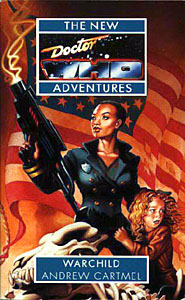
Enter Roz Forrester, hardbitten cop from the future. Originally set up as half of a comic relief double act in Original Sin, along with her boyish partner Chris Cwej, she wasn't originally intended to be a companion. The Doctor was going to take on a homeless man, but that wasn't working out, so the homeless guy became a homeless alien, and Roz and Chris became the new companions.
Where Chris is masculine, good-looking, guileless and always trying to do the right thing, Roz is middle-aged, grumpy, cynical and can't shoot straight. She's also a right-wing bigot. Oh, and she's fabulous!
Roz is deeply prejudicial against aliens. This is because she exposed a scandal and killed her former partner for corruption, but she had implanted memories that blamed his death on aliens. Even after she finds this out, she retains her dislike of aliens, remaining grumpy and cynical throughout her time with the Doctor.
This of course makes her excellent comic relief, because she can do the snarky commentary that makes the books a lot more fun. She's also the only person the Doctor has ever dropped his facade for, according to Zamper.
The fact that she's also the first non-white companion is almost incidental. The politics of the NAs had stood them in relatively good stead for introducing a black companion and not making it embarrassing. For example, in Just War, she's implicitly accepted by the allies as not a Nazi, on account of the fact that she couldn't possibly be one. In Toy Soldiers, she pays her first visit to Earth's past and has to actively learn that people are being racist towards her, making the link between these attitudes and her own regarding aliens. But this isn't a Very Special Episode of the New Adventures; she still keeps her prejudices, even as they're tested.
In what effectively became the grand finale of the NAs, Roz returns home and is killed fighting a civil war in So Vile a Sin (the last book to be published in the line, albeit not the last set, due to a hard disk crash). It's a tragic end, but one that was foreshadowed throughout much of her time. And the aftermath is quite brutal: the Doctor and Chris feel the effects for several books afterwards in quite deep ways.
Of course, killing the right-wing black woman might not be the best optics, especially when viewed through a 21st century lens. But that one-sentence summary ignores all the amazing character work that went into Roz's development and subsequent journey. It ignores just how likeable she is, despite being the antithesis of everything the NAs were espousing at the time. And, this being science fiction, she even came back later: once in a book of short stories set throughout the dynasty of her family (Decalog 4: Re: Generations) and once in the Bernice Summerfield novel Oblivion, when the universe shifted and Roz was now no longer dead (although her proper timeline is restored at the end).
So let's hear it for the wonderful character that is Roz Forrester. Her existence shows that drama is best served when you actively try and address all sides rather than preach to the choir. She's fun, funny and immensely likeable, even though you can't figure out how this is the case given her setup. And, in the end, she's the ultimate answer to the question of just who Doctor Who is for: in good times or bad, in sickness or in health, Doctor Who is for everybody!