THE DOCTOR WHO RATINGS GUIDE: BY FANS, FOR FANS

|
The Sarah Jane Adventures
The Mad Woman in the Attic
|

|
| Story No. |
14 |
|
| Production Code |
Series Three Episode Two |
| Dates |
October 22-23, 2009
|
With Elisabeth Sladen, Daniel Anthony, Anjli Mohindra, Alexander
Armstrong, Tommy Knight, John Leeson
Written by
Joseph Lidster
Directed by
Alice Troughton
Executive Producers: Russell T Davies, Nikki Wilson.
|
|
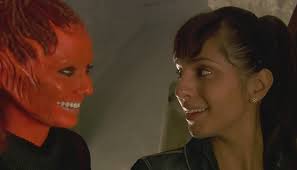
Synopsis: In the future, an elderly Rani is living in the Bannermen Rd attic, having lost everything.
|
Reviews
Past Glories by Stacey Smith?
5/1/26
The Mad Woman in the Attic features the first-ever clips from Classic Who shown not only in The Sarah Jane Adventures but in any Doctor Who spinoff series. This is not a coincidence. The Mad Woman in the Attic is a story positively obsessed with the past, both as a concept and as a storytelling vehicle, particularly in the way that the past informs the future.
Most obvious is the framing device, with an older Rani narrating the events to Adam, a young boy from Bannerman Road. Rani herself has ended up living in Sarah's attic in 13 Bannerman Road and spends her time mourning the loss of her friends, surrounded by old photographs, recordings and memories. It's a surprisingly heartbreaking take for a children's series, because focusing on the loneliness of old age is not usually the stuff of fun kids' TV.
What's more, this is a story that has... erm, aged well. Back in 2009 --- when David Tennant was the Doctor, former companion Sarah Jane Smith was starring in her own adventure series and Russell T Davies reigned supreme, with multiple spinoffs and a thriving Doctor Who media presence --- this was yet another decent weekly adventure. Viewed today, more than a decade after Elisabeth Sladen's passing, and in a very different TV landscape, this is tough viewing, but all the more rewarding for it.
Even at the time, seeing flashbacks to a young Sarah Jane Smith in Planet of the Spiders was a powerful reminder that a lot of time had passed. Now it feels like a huge volume of water has flowed under even that bridge, even though 2009 wasn't all that long ago in the scheme of things. Rani says that her attic is full of ghosts, and truer words could not be spoken in the 2020s. The fondness I had in 2009 for a dim and distant past of 1974 is exactly the feeling I get now for The Sarah Jane Adventures. There's a word in Japanese for this: natsukashii, the feeling of evocative longing for something past: a nostalgia that's also very sad, as it reminds you that what you're remembering will never come again.
However, the story's connection to the past runs much deeper than just the framing device, as powerful as that is. Present-day Rani has an old friend Sam (despite us never having heard of him before), who's such a good friend from her old life that she regularly emails him top-secret information about aliens and so forth. This is mirrored by Sarah Jane and Clyde's conversation with Maria, Rani's predecessor in the series, who doesn't appear in this episode (except for flashbacks) but has two pivotal moments: in the present, she's the fondly remembered former sidekick that the original cast fawn over, resulting in present!Rani's discombobulation that kick-starts the plot; in the final scene, future!Rani returns from visiting Maria, suggesting a resonance and connection between the two characters, despite the fact that they never appear on screen together in any episode.
When Rani gets to the amusement park, she meets Harry, a guest star of the week --- who's nevertheless deeply connected to the world of past Doctor Who, as he was Dugdale in Snakedance back in the eighties... but, more importantly, he's Mr. Elisabeth Sladen, calling a resonance that's in no way explicit on screen but which every fan watching will know. Amusingly, when Rani meets Harry, her ruse to stay in the park is that she's twisted her ankle, calling upon a well-known past Doctor Who cliche (one that Sarah Jane herself performed purely for nostalgia reasons in The Five Doctors), but this time for comic effect. Kids watching will think it's a random excuse to stay and investigate; long-time fans will find a deeper meaning there.
Rani ponders an old photo of Harry on his desk that has no particular relevance to the plot. However, it gives him the chance to talk about what things were like 50 years ago and reflect on the passage of time. His explanation of why the park closed echoes this: with the credit crunch, having fun is now a luxury of the past. What's interesting is that there's no sinister alien plot behind the closure of the theme park; it really is closed because the present can't step up to the expectations of what came before.
Indeed, this is the only Sarah Jane Adventures story without a villain. Eve and Ship are both shown to be misguided in a few places but clearly not villainous (despite the ominous incidental music that initially greets them). Instead, the villain here is time and the effects it has upon our memories.
While searching for Rani, Sarah Jane and Clyde banter about her age, with Clyde dissing her for getting old and having memory problems. This was played for comedy but has another unexpected future connection, as that will be precisely the plot of Goodbye, Sarah Jane Smith, in the fourth season. Watching now, jokes about Elisabeth Sladen's age a mere two and a half years before her death just don't play the same way they did back then.
When we meet Eve, we discover she's a refugee from the Time War, having fled the Daleks. Except we're not quite told this in so many words, instead told that her people could read the timelines, and that attracted the attention of one of the races from a war, who proceeded to exterminate her people. Without context, this would just be a random backstory. However, those with an eye to the history of Doctor Who will not only recognise the word "exterminate" (which most casual viewers will these days associate first and foremost with the Daleks, rather than any other context) but they'll be able to put the pieces together to realise this is related to the Time War, using the narrative codes that link to the viewer's own past.
The Sarah Jane Adventures were marked by every story being broken into two, with a cliffhanger, once again drawing on a nostalgia for a time long gone (very few of the Davies-era Doctor Who stories had cliffhangers). Usually, these are very traditional menaces or occasional revelations. However, the mid-story cliffhanger to The Mad Woman in the Attic isn't the reveal of the alien Eve or the possessed zombies in the amusement park; instead, it's the existential fear of growing old and lonely, as Rani is given a glimpse into the future that we see in the framing device. That's quite a brave choice for a children's show.
Upon possession by Ship, Sarah Jane is shown both flashbacks and flash-forwards. The former include both Planet of the Spiders and The Hand of Fear, as well as The Stolen Earth in the much more recent past, although from today's perspective that's yet another reminder of a time now lost. There are also in-series flashes to various Sarah Jane Adventures stories, as you might expect. What's less predictable are the flash-forwards to the TARDIS landing in the attic, which is a supremely powerful moment. Indeed, it's the first time the TARDIS is seen in any spinoff (it was only heard during Torchwood's first-season finale). The ultimate reveal of David Tennant's appearance is a glimpse into next week's story, The Wedding of Sarah Jane Smith, while also being the first time the Doctor has appeared in any televised spinoff, something that would become more commonplace in future. (Matt Smith will go on to appear in next season's Death of the Doctor, while Peter Capaldi appears in the opening episode of Class.)
We also see flashbacks and flash-forwards for Luke. The flashbacks are all to previous Sarah Jane Adventures episodes, of course, while the flash-forward is to his graduation, which will occur at the beginning of the next season, in The Nightmare Man. It's debateable whether this one was deliberate or not; it's a generic enough thing for Luke that it could have just been thrown in. However, since both stories are by Joseph Lidster, it's possible that this one was nothing more than a continuity reference that got revisited later on. Interestingly, on discovering his Bane origins, Sam compares Luke to Frankenstein (or rather, his monster), which is a different kind of past recollection, harkening back to the very first science-fiction story ever written.
When Sarah Jane and Clyde enter the haunted house in search of Rani, they're menaced by a fake clown, causing Sarah Jane to gasp before she realises it's fake. While this would be an ordinary reaction to something leaping out at you in a haunted house, the callback to last season's Day of the Clown is surely deliberate, adding resonance to an already effective scare for those with long memories, while not confusing anyone who doesn't. That's this story all over: using the past to add layers without relying on it as a crutch.
This comes together at the end, when Eve and Ship need a black hole, bringing us back to K9's mission from Invasion of the Bane. The return of K9 to the series is a cute development if you're a kid who likes the adorable robot dog, but the reuniting of Sarah Jane and K9 in their own spinoff series is a triumphant moment that finally sees John Nathan-Turner's vision from 1981 come true. Our memories are long, even for the futures that never were.
Speaking of futures that never were, the older Rani's lonely future is erased thanks to Adam, who turns out to be Eve and Sam's son, repaying a generational debt from the distant past. The lonely future is replaced by a happy one, where Rani is surrounded by family, running missions with Maria and having a full life. Viewed retroactively, in the absence of a series finale --- due to the fifth season being cut short by Sladen's death --- the restored future for Rani (implied to be married to Clyde) serves as the closest thing The Sarah Jane Adventures has to a conclusion. The group photo of Sarah Jane, Clyde, Rani and K9 in the present becomes the past of the new future, a snapshot in time...
...which is exactly what The Mad Woman in the Attic is now to us. It's a fond visit to a past that's gone, and one that can never be recreated. We might not be alternate versions of ourselves living in Sarah Jane's attic, but we're still receding from it in time, and it's a process that brings up both the happiest and the saddest of feelings. But that's the past all over, really. Natsukashii.