THE DOCTOR WHO RATINGS GUIDE: BY FANS, FOR FANS

|
BBC
The Star Beast
|

|
| Story No. |
332 |
|
| Production Code |
Series 14 special
|
| Dates |
November 25,
2023
|
With David Tennant, Catherine Tate
Written by
Russell T Davies
Directed by
Rachel Talalay
Executive Producers: Russell T Davies, Julie Garner, Jane Tranter, Joel Collins, Phil Collinson
|
|
Synopsis: A tiny alien crashes near where the Doctor has accidentally run into the one person he really shouldn't.
|
Reviews
'Once Upon a Time Lord' by Niall Jones
22/12/25
It's late 2025, and Doctor Who is not in a good place. The last series, Series 15 (or should that be Series 2?) concluded with an underwhelming finale and ended with a shock regeneration, as Ncuti Gatwa --- who had previously been set to star in at least one more series --- transformed into a familiar face, who may or may not be the Sixteenth Doctor. Additionally, the BBC's deal with Disney to make the show appears to be on ice; and, while there is a spin-off, there don't appear to be any more series of Doctor Who in the pipeline. It's all a bit confusing, but worse than that is the sense that nobody really cares anymore. Viewing figures aren't what they once were and, despite a couple of outstanding episodes, the past two series have received a mixed reaction from fans, with a vocal portion of fandom pinning the blame for the series' failure on Russell T Davies and his commitment to a 'woke agenda'. Much of this criticism is unmerited, but it is nevertheless clear that Doctor Who hasn't been firing on all cylinders for some time.
Go back two years, and things look rather different. Davies is Doctor Who's white knight, returning to save the show from potential cancellation. But Davies isn't the only figure returning from Doctor Who's past. Also coming back are David Tennant as the Doctor and Catherine Tate as Donna Noble.
The origin of their return to Doctor Who goes like this: following on from a Lockdown-era tweetalong, Tate texted Davies to say that it would be fun to return to the series, later adding that Tennant was interested too. Davies knew that Chris Chibnall was stepping down as showrunner and approached the BBC with an idea for the 60th anniversary involving the three of them.
The return of so many figures from Doctor Who's past inevitably raises the spectre of nostalgia. The Star Beast certainly does look back to Doctor Who's history, but it also looks forward to the future. The return of David Tennant is admittedly self-indulgent, but a bit of self-indulgence is forgivable in an anniversary year. In fact, it may just have been the point. Davies has always been canny about attracting attention, and bringing back Tennant was the perfect way to draw attention to a show that had largely fallen out of favour with the British viewing public. For many, Tennant remains the Doctor, just as Tom Baker was for an earlier generation. In that respect, Tennant more than delivers, falling effortlessly back into his old role with charisma, intensity and imperiousness. By bringing back the version of the Doctor synonymous with the revived series' peak popularity, Davies seeks to remind audiences of why they liked Doctor Who in the first place.
If the return of Tennant as the Doctor is inevitably self-indulgent, then the return of Donna Noble helps to stop the episode from being pure nostalgia. The Doctor's decision to remove her memories of their adventures together, in order to save her life in Journey's End, meant that Series 4 ended on a tragic note. Sneakily ensuring that she won the lottery in The End of Time Part Two softened the blow, but Donna's exit from the series has, nevertheless, sat poorly with many fans. The fact that Donna will die if she recognises the Doctor is addressed in the episode's opening minutes. Narrating over clips from Series 4, along with present-day footage of Donna, the Doctor recaps her story and establishes the stakes. Donna's return is thereby rooted in anxiety, but it's an anxiety that leads to anticipation. Viewers know that Donna isn't going to die --- after all, she has two further adventures with the Doctor to go on --- but they don't know exactly how the situation is going to be resolved, creating a tension between what should happen and what likely will. All of this signals that Davies' decision to bring back Donna isn't purely nostalgic. She's back not just because she's a great character, but because her story hasn't ended yet. As Davies puts it in an interview with Entertainment Weekly, 'I realized that there was a third act to be written'. The past is there not just to be paid tribute, but to be questioned and challenged.
The Doctor's initial encounter with Donna at London's Camden Market (a stone's throw from my old office) neatly balances the competing pressures of nostalgia and novelty. Audiences are instantly reminded of the old Donna --- mouthy, funny, liable to miss the spaceship crashing right in front of her --- but her situation has changed: she now has a teenage daughter, Rose, who is transgender. The introduction of Rose helps to shift the focus away from Donna as an individual and towards her as part of a family. In fact, one of the episode's biggest innovations is the way in which it fleshes out previously anonymous members of Donna's family. Her husband, Shaun, is revealed to be a kind and stoic family man, who sticks by his wife, despite her eccentric decisions; her mum, Sylvia, who had previously come across as slightly one-note, is also given more nuance. In particular, her conversation with Donna about her own awkwardness relating to Rose, given her change of gender, feels honest and provides a sympathetic but not preachy look at the challenges of raising a transgender child.
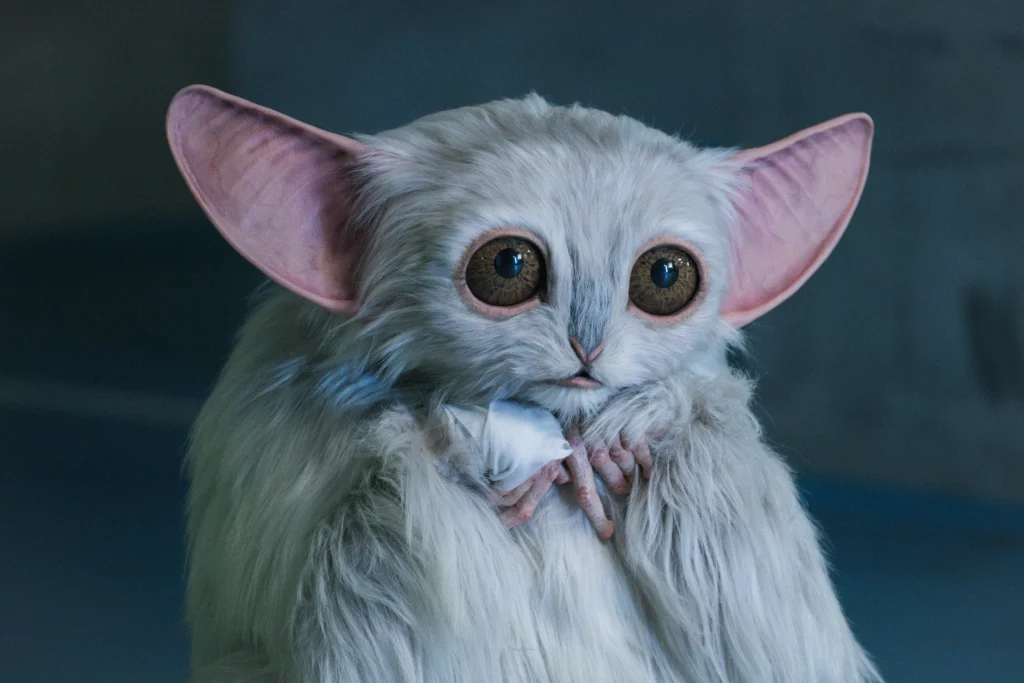
While The Star Beast's main attraction may be its characters, its plot is also very strong and proves to be far more substantive than many of Davies' previous series openers. Based on a 1980 comic strip written by Pat Mills and John Wagner and illustrated by Dave Gibbons, it takes the story of a cute, persecuted alien who crash-lands on Earth and turns it on its head. Here, the cute alien is called the Meep. A big fluffy owl with enormous bat ears and large protuberant eyes, the Meep has a gorgeous and unusually physical presence in the episode, as it is created through puppetry rather than CGI. Voicing the Meep is Miriam Margolyes, an actress whose skills have often been eclipsed by her outspoken and outrageous persona. Margolyes does a brilliant job voicing the Meep, endowing it with an endearing sense of mania and committing fully to its cuteness, often pronouncing words in a deliberately childlike way. In fact, Margolyes' Meep is so convincing that it almost appears too good to be true...
...and it is. The Meep turns out to be not an innocent hunted for its fur --- a 'literal fashion victim', as the Doctor puts it --- but an insane war criminal. This twist is well-handled, with the Meep's physical transformation --- the eyes turning evil and sharp teeth descending --- matched by an equally sinister transformation in Margolyes' vocal performance. The moment is hugely satisfying, even if you already know the twist.
The story of the Meep unfolds alongside Donna's story; as more and more strange things happen, Donna becomes increasingly aware of who the Doctor is. These dual aspects of the plot dovetail, eventually merging into each other: in order to defeat the Meep, the Doctor has to return Donna's memories. At this point, things look familiar. The Doctor has made a terrible, but inevitable choice: the Meep will be defeated, but Donna will die. He will have won, but at a terrible cost. This isn't what happens, however. For once, there really is another way. While much of Davies' writing for The Star Beast --- the focus on family, the juxtaposition of the ordinary with the alien, the balance between action and comedy --- is familiar from his previous stint as showrunner, here things have changed. In fact, Davies seems to have learned from Steven Moffat. Whereas most of Davies' previous finales build towards tragedy, Moffat's (in particular, his three finales for Peter Capaldi's series) begin with tragedy and build towards hope. That is exactly what happens here, and it allows Davies to rewrite a previous wrong, freeing Donna from her fate.
While this outcome is the right one, the exact mechanism that leads to it is somewhat muddled. The basic idea is sound --- Donna passes her Time Lord consciousness down to Rose and together they are able to neutralise it --- but their explanation of what happens amounts to Davies' only major misstep in the episode. Donna tells a confused Doctor that his previous regeneration would have made sense of it, while Rose adds that what they have just done in letting go is 'something a male-presenting Time Lord will never understand'. The phrase 'male-presenting Time Lord' is uncharacteristically clunky, while the idea that, as a man, the Doctor will never be able to understand feels steeped in stereotypes and goes against the episode's earlier rejection of gender binaries. The explanation doesn't make a lot of sense, and it's the one point in the episode that feels overtly preachy.
Despite this misstep, The Star Beast remains an excellent reintroduction to the world of Doctor Who. In some ways, it even resembles that ultimate reintroduction, Rose --- if Rose featured the return of Grace Holloway. It's funny --- case in point, the conversation between the Doctor and Shaun in the taxi --- exciting and generally deals with serious issues around transgender and disability rights lightly and naturally. Extra money from Disney and strong directing from Capaldi-era veteran Rachel Talalay also ensure that it looks amazing. The next two years may not always be plain sailing, but Davies' second stint as showrunner certainly gets off to a strong start.