
Twice Upon a Time
Doctor Who - Twice Upon a Time

|
Twice Upon a Time |
Target novelisation Doctor Who - Twice Upon a Time |
|
| Author | Paul Cornell | 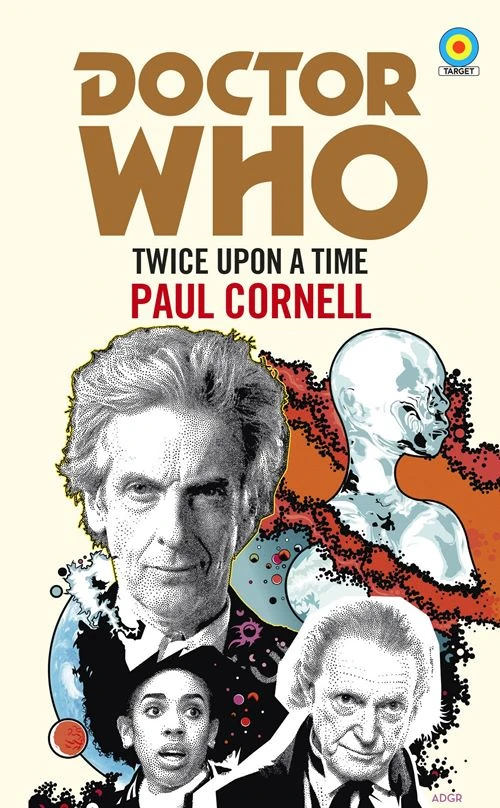 |
| Published | 2018 | |
| ISBN | 978 1 78594 330 0 | |
| First Edition Cover | Anthony Dry |
| Back cover blurb: Still reeling from his encounter with the Cybermen, the First Doctor stumbles through the bitter Antarctic wind, resisting the approaching regeneration with all his strength. But as he fights his way through the snowdrifts, he comes across the familiar shape of a blue police box, and a mysterious figure who introduces himself as the Doctor... Thrown together at their most vulnerable moments, the two Doctors must discover why the snowflakes are suspended in the sky, why a First World War Captain has been lifted from his time stream moments before his death, and who is the mysterious Glass Woman who knows their true name. The Doctor is reunited with Bill, but is she all she seems? And can he hold out against the coming regeneration? |
Should Auld Acquaintance Be Forgot by Niall Jones 17/10/25
For all that Doctor Who fans have a tendency to pin responsibility for a particular episode on its writer, a piece of television drama really has multiple authors. The director, producer, actors and even the composer all play key roles in its success or failure. For a novelisation, however, it is different. The name on the cover really is the sole author. When the novelisation of Kerblam! was released in 2023, author Pete McTighe described it as the 'definitive version of the story'. Freed from the constraints of a 50-minute running time, it was a chance to expand upon his original ideas, further develop characters and add extra backstory. Similarly, for episodes marred by poor production choices, a novelisation can provide a second chance for the story to succeed.
What is unusual about Doctor Who --- Twice Upon a Time is that this logic most definitely does not apply. Although based on Steven Moffat's 2017 Christmas special, it is written instead by Paul Cornell. There is, therefore, no way in which the novelisation can be considered the 'definitive version of the story'. Unlike other recent novelisations, Cornell's take on Twice Upon a Time sticks closely to the original script and adds little in the way of extra backstory or plot. This doesn't mean, however, that it's not worth reading. While it may tell the same story as the TV episode, the way in which it tells it is subtly different and inherently literary.
What Cornell's novelisation does is to tell the story from the inside out. The focus is less on the events themselves and more on the ways in which the characters understand them. Key moments in the TV episode, such as the recreation of parts of The Tenth Planet or even the regeneration, feel relatively muted on the page. This is not because Cornell writes them badly, but because, as a writer, he doesn't have the same tools as the creators of the TV episode. There is no way for him to evoke, for example, the triumphant moment in which black-and-white becomes colour, so he wisely avoids trying. Instead, he uses the tools available to him and gets inside the characters' heads. The key question that Doctor Who --- Twice Upon a Time asks is why: why don't the two Doctors want to regenerate? What eventually changes their minds?
Cornell presents the Twelfth Doctor's reluctance to regenerate as being fuelled by his experience of love. After he accidentally refers to World War One in front of the Captain, Cornell asks, 'What would the Doctor's wife, River Song, say in the circumstances?' Indeed, River is casually referenced several more times during the book, though, crucially, never in the dialogue. She's simply always in the Doctor's mind. Cornell not only emphasises the closeness of their relationship but also considers the way in which the Doctor's experience of matrimonial bliss affects his view of himself. Cornell writes:
In all his years of life in this incarnation, he had finally learned some lessons about human life that his other selves had not. He had enjoyed, for decades, the dream of a normal existence. He had had love, long-lived love. He still wore his wedding ring. This time, if he allowed the regeneration to happen, he would not just be sacrificing some iconic hero, he would be losing a life.Deprived of his memories of Clara, the 24 years he spent with River Song on Darillium becomes the defining experience of his life. While the Doctor's relationship with River is referenced throughout Series 10, most explicitly in Extremis, Cornell brings it to the fore and establishes it as key to understanding his character. In contrast, the absence of Clara is only brought up at the very end of the series, when Testimony gives him back his memories of her. In the novelisation, the Doctor's encounter with Rusty provides a key example of her importance to a story in which she barely features. By bringing back one thing from the Twelfth Doctor's past, the absence of something else becomes all the more visible. Describing their previous encounter, Cornell writes that, 'Miniaturised, he and … there had been others with him, he was sure, but he couldn't remember their names… they had gone inside this Dalek's casing, right inside its brain.' In a story in which memory is emphasised as being key to identity, the absence of a memory becomes an especially acute problem. This highlights the significance of the Doctor's reunion with Clara and links it to his decision to regenerate. As he later notes, 'To see her again was to see hope.'
Much the same is true for the First Doctor, with Cornell stating that part of his reason for not wanting to regenerate is, 'Because he had wanted to see his granddaughter, Susan, once again, in this form, as the old man she had loved'. The idea of regeneration as a form of death is hardly new, but Cornell takes it especially seriously here. Of course, the First Doctor knows about regeneration, but the idea that he could live on beyond the only life he has ever known seems so alien as to be almost unimaginable.
Although the First Doctor who walks through the pages of the novelisation is largely given the same dialogue as on TV, there are differences in how Cornell presents him. In particular, there's little sense of David Bradley's performance in the character. In fact, the inclusion of a 'hmm' after many of his pronouncements feels like a slightly lazy way of evoking William Hartnell's mannerisms. What Cornell does particularly well, however, is to capture the First Doctor's sense of being simultaneously old and young. He fills his TARDIS with antiques, but doesn't know how to fly it properly, or even how to change the lights. There's even a suggestion that his sexist comments are intended expressly to annoy his future self, characterising him less as a grumpy old misogynist, more as an edgy teenager who delights in shocking his elders.
The other main characters in the story, Bill and the Captain, are presented much as they are in the TV episode, but Cornell fleshes out their personalities by merging their perspectives and idioms into the narrative voice. For Bill, the First Doctor is 'a lovely old codger', while the Captain (or Archie, as he is properly called) refers to the two Doctors as 'the English one' and 'the Scottish one'. At times, this has a comic effect, such as the moment after the First Doctor declares to his future self that, 'You may be a Doctor, but I am the Doctor', in which the Twelfth Doctor is referred to as 'the medical man'. By doing this for all the main characters, Cornell creates a sense of multiplicity, allowing the reader to see the story from multiple perspectives.
While Cornell does little to embellish the plot, he nevertheless adds small details that enhance the story. For example, we learn more about what happened to Bill and Nardole after the events of The Doctor Falls. He also adds extra jokes, such as the Doctor having a VHS copy of The Daleks' Master Plan, and references to unseen adventures with Mary Berry and Clive Dunn.
Cornell's style of writing is simple, but effective. Sentences and chapters are short and ensure that the narrative moves at a similar pace to its source material. In fact, the novelisation can be easily read in a single sitting. This feels in keeping with the heritage of the Target line, with the novelisation being a children's book that can also be enjoyed by adults. There are also references to earlier novelisations, including an allusion to the famous opening line of Terrance Dicks' adaptation of The Dalek Invasion of Earth and a chapter entitled Escape to Danger.
What Doctor Who --- Twice Upon a Time does is to take the original story and provide an internal view of it. By entering the characters' heads and putting their thoughts on the page, Cornell draws out elements implicit in the original story and makes them explicit, heightening their emotional tenor. The novelisation in no way replaces the original story, but, by deepening it and subtly changing its emphases, it acts as an excellent companion to it.