THE DOCTOR WHO RATINGS GUIDE: BY FANS, FOR FANS
| Story No. |
278-279 |
|
| Production Code |
Series 9, episodes 3 and 4
|
| Dates |
October 3 and 10,
2015
|
With Peter Capaldi
Written by
Toby Whithouse
Directed by
Daniel O'Hara
Executive Producers: Steven Moffat, Brian Minchin.
|
|
Synopsis: What caused a Scottish seabase to flood and ghosts to appear?
|
Reviews
I had a prawn sandwich. Might have been off. by Hugh Sturgess
2/3/24
Under the Lake/Before the Flood is the most retro story of Series 9, and probably of the Capaldi era generally. Not merely does it invoke that reliable standby of Paleo-Who, the base under siege, in its structure it is more of a piece with the old series than the new. In short, it is the return of another Paleo-Who classic: the over-padded six-parter. All the narrative tricks and tactics neo-Who used to squeeze and compress a Doctor Who story into forty-five minutes are undone, tightly compressed plot points and revelations unspooling into two slow, undercooked episodes that in no way justify their length.
Apparently Whithouse told Moffat that he only had time to write a single episode, but agreed to stretch it to two when told that was the format of the season. It shows, but there is something interesting in how slow and padded it is. We don't normally get the chance to ask: what does padded Doctor Who look like in the twenty-first century? Whithouse is initially quite stylish in how he slows the pacing. Rather than racing through the set-up the way most episodes of neo-Who do, he slows down the process of exploration and discovery for the first time since probably the last time the series had an underwater base under siege, Warriors of the Deep (a bad omen). The general judgement of fandom at the time seemed to be that this made a welcome change from ultra-quick leaps of logic and infodumping, and I agree. This is procedural Doctor Who, showing how the characters develop questions and begin to answer them.
Seen as a whole rather than week by week, the man behind the curtain is obvious. Removing the suspended animation chamber from the spaceship and putting it in the church doesn't affect the plot of the story, but it does slow it down - requiring the unmanned sub scene. No one comments on the undertaker's garb of Prentice's ghost, so that can be held back for the second episode, where the detail that Prentice is a Tivolian lets Whithouse include variations on the original Tivolian jokes from The God Complex. The biggest structural delay is the ghost Doctor, who is introduced at the end of the first episode to provide a clear, exciting idea around which to structure a second.
This is all just stalling for time, but in its way it's elegant. Making such a big deal of discovering the questions in Under the Lake makes the episode intriguing in a way few other episodes of modern Who are. Rather than a constant train of twists changing our understanding of what kind of story it is, just a slow, painstaking reveal of additional pieces of a largely unfinished puzzle. It must be said that lot of the "explanation" doesn't make sense. The unforgivably terrible astronomy in Under the Lake, in which the Doctor says that Earth is the fourth point of Orion's sword, is a dumb thing to have in an episode that is focussed on the "figuring it out" stage of things. Nevertheless, it's thinking intelligently about how to slow down the plot. This was a worthy experiment.
But then the story falls to pieces in the second half. If Under the Lake was intelligently and carefully thinking about how to stall, Before the Flood is panicking and throwing in random plot devices to fill out the running time.
All of the questions Under the Lake set up for us are either forgotten about or resolved in the most disappointing way. The Doctor spends an entire scene in Under the Lake enthusing about the existence of the ghosts, treating it as something entirely outside his experience. Death is the only thing unifying every living thing in the universe - until now! But Before the Flood shows that that was just Whithouse's way of turning a small scene into a bigger one. How the Fisher King created the ghosts is never explained, and why they can only come out at night is explained away in a line of dialogue that sounds like the work of ADR. Having made such a big deal of the ghosts in the first episode, to then ignore them is cheap and cynical.
The mysteries were "who created the ghosts" and "why". The answers are "the Fisher King" and "to invade". But who is the Fisher King? The episode wants him to be a terrifying, skeletal death-monster capable of violating the laws of life and death, yet the only notch on his belt is having enslaved the Tivolians, of all people. Whithouse used the Tivolians so he could fill the scene with Prentice with jokes about Tivolians, either not noticing or not caring that it made the Fisher King's pretensions to greatness hilarious. What about the people who overthrew him? Wouldn't they be the bigger threat?
Two major elements of Before the Flood's runtime is the TARDIS going backwards on its timeline by half an hour and Clara looking for her phone. This is the purest padding in the entire bloated story, as none of it has any impact. Why have the Doctor and Bennet double back on themselves and do nothing with it? At the time, the Doctor's line that seeing people after they've died is like seeing ghosts seemed to be heavy foreshadowing about Clara's death (you may remember the fan theory that the Doctor in Series 9 had already lost Clara and then gone back to have a few more adventures with her), but now it's just dead air. It was foreshadowing nothing, it just wasted time. Ditto with Clara's phone. That is virtually her only action in Before the Flood. They go to an enormous amount of effort to keep the phone so the Doctor can call her again, which he never does. The entire search for the phone is a pointless quest.
Before the Flood's cold open, in which the Doctor explains the bootstrap paradox, is an intriguing way to start, and makes an interesting mid-point to the story. It doesn't come at any point in the narrative, and the Doctor blatantly breaks the fourth wall by delivering his monologue to camera. It's a fascinating stylistic experiment on the series' part, and would have been a lot better had it been about something else. Do we really need an explanation of how a bootstrap paradox works? Not once before has the series had such a low estimation of its audience that it has felt it necessary to explain that paradoxes are paradoxical, innit. It is breathtakingly cynical to spell out at tedious length one of the most commonplace elements of time-travel stories just to play for time. It is also a damning indictment that by far the best part of the story is a scene unconnected to anything else that explains something we already knew.
The bootstrap paradox is essentially an excuse for Whithouse to create incident that is unmotivated by anything other than "it happened because the characters knew it had to happen". Why did the Doctor create the ghost Doctor and not a message for Clara? Because Clara told him it had happened. Why does the ghost Doctor release the other ghosts (which nearly gets the others killed)? Because Clara told him it happened. If there is a thematic connection between the "repeating thirty minutes" stall and the rest of the story it's that it's the same idea: the Doctor and Bennet do nothing because they know they didn't.
For the story to openly brag about this in the cold open is fucking bizarre, frankly. I'm apparently in the minority on this, but bootstrap paradoxes are not inherently interesting or cool in a show about time travel. Moffat basically did everything interesting you can do with them in Blink in 2007, and more importantly, Blink was actually about something. Typical of Moffat's interest in how to structure a story, it was a formal experiment in how time travel changes the shape of a story. But Before the Flood appears to think that bootstrap paradoxes are intrinsically clever so it doesn't have to be about anything.
It's not as though there wasn't anything else the story could have spent its time on. In a story this padded, there is an awful lot left undeveloped. The crew of the Drum is woefully under-characterised, each possessed of a single trait from TV-land. Moran, for his few seconds of life, is the gruff, no-nonsense commander. Pritchard is the odious corporate bureaucrat who says and does things no real person would ever do. He's worried about his bonus when homicidal monsters are prowling around, and tells the Doctor that as if expecting other people to understand this point of view. Not even Donald Trump would do that. And he only dies because he goes outside to search the lakebed for the power cell, when the base has an unmanned sub! O'Donnell is a Doctor-fangirl. Great. Furthermore, her death is horribly handled. When the Doctor tells her to stay behind, she blithely refuses, so when she dies it looks like punishment for not doing what she was told. All her death does is to reveal Bennet's out-of-nowhere love for her, and all that does is set up the equally out-of-nowhere Cass/Lunn romance. And isn't it convenient that the characters pair up in such neat heterosexual couples? One almost wonders if Whithouse made Cass deaf just so her lines took just that little bit longer to deliver. Populating the story with TV clichés is forgivable if it's in the interest of brevity; what's the excuse here?
The backstory to the 2119 scenes is thin and unoriginal. Another military facility, another greedy corporation. Why not stretch out the story by making it interesting? Did anyone seriously, at any moment, believe the show was set in the future? 2119 is a hundred years from now, and yet it's indistinguishable from the present day. Cass invokes both Ghostbusters and Cabin in the Woods! This isn't Whithouse's sin alone, but I can't tell you how annoying it is to see people centuries in the future display the exact social and pop-cultural concerns as late-twentieth/early-twenty-first century westerners.
Why hire Paul Kaye to play Prentice and give him only a single scene in which to actually act? All he does is repeat jokes David Walliams made in 2011. Why hire a high-profile actor and just have him spend two episodes wandering about saying lines no one can hear? This is perhaps the biggest mystery of all.
Under the Lake and Before the Flood are not irredeemable. The ghosts are suitably menacing, and the scene in which the ghost of Moran stalks Cass, who can't hear the sound of the axe being dragged across the floor, is frightening and gripping. However, the story is a disaster as a two-parter, and a disaster for coming so early in a season trying to sell us on two-parters as a regular format. Instead of showing us how two-parters can be an exciting, innovative structure, Under the Lake/Before the Flood reheats all the worst flaws of the form, and insults the viewers' intelligence by openly admitting that much of the story only happens "because".
A Review by Thomas Tiley
17/10/25
The premise is interesting: the Doctor meets real-life ghosts in an underwater base, only no they are some kind of electromagnetic message to the stars from an alien would-be conqueror, so he has to travel back in time to see what that's all about.
Other than making a strange comment about liking adventures with explosions/action (suggesting that she is becoming more Doctor-like and reckless as per this year's mandatory story arc) and then the threat of something happening to her motivating the Doctor into action (per story arc of the two of them together, motivating and pushing each other, egging the other on to more outrageous stunts and acts), Clara really doesn't get much to do outside of one or two moments and therefore not much of a chance to shine like she did last year. Maybe they took in some of the complaints about the show becoming more about her, or maybe she got caught up in that old complaint in the sense that the writer needs to write the story but doesn't think much about the companion for whatever reason (such as is just on a deadline or hasn't got a handle on the character or just plain doesn't care) so just writes it as a generic companion type and hopes the actor/actress can fill in the blanks with their performance that used to litter older Doctor Who series (and a few newer ones).
Capaldi gives a good performance, as always. His speech about the ghosts is very good, even if the truth about them is so prosaic that it makes the speech seem silly. The bit where he works out the message is good, even if the author doesn't understand flaws of using constellations as coordinates (constellations only look the way they do from one frame of reference; the minute you move to another planet, it becomes useless as you're in a new position; new position means the stars are in different places compared to before, meaning nothing matches and you have to start again from scratch).
While the underwater base is a new setting for the post-2005 series and it does look nice, it also looks very familiar with parts reused from the opening Dalek/Missy stories and later reused as a space station in a later story Sleep No More. The Fisher King has an interesting design and intriguing name; he is also completely wasted as a generic monster that goes around shooting people with a ray gun.
Some of the twists and turns of the story are rather stupid (basically most things past the first episode, especially everything involving the ghost/holo-Doctor or pointlessly travelling Back to the Future--style into moments and scenes that have already happened, only without anything interesting visually or storywise happening), but even part one has the walking cliche that is barely a character and only a type: the stereotypical businessman who is so profit-obsessed it gets him killed. Some points are obvious: who is in the capsule, the missing power cell, why do the ghosts not attack the only member of the team not to look at the strange writing in the recovered spaceship. The opening to the second half has the Doctor address the audience and explain the concept of the bootstrap paradox --- AKA basic time travel stuff --- before leading into a revamped version of the theme tune. Depending on your sensibility, this was either a bold and exciting experimental move or a warm-up or glimpse of a similar technique that is used in Heaven Sent or a borderline insulting sign that the creative crew don't expect you to be able to follow the a very classic time-travel plot. Maybe after complaints about earlier Moffat lead series of New Who, they just think the average viewer is too thick to understand, so they just have to dumb it down for us viewers. Of course, there is also the possibility that the writers aren't that clever either. Only the rather boss guitar version of the opening theme makes up for it.
There are some effective set pieces such as the ghost with the scraping axe following the deaf base commander; that entire sequence/scene is fantastic, with the juxtaposition between her point of view and the viewers; probably the best scene in the story actually. While his character is underwhelming, the Fisher King's demise is well executed with his final roar as the influx of water drowns him.
The supporting cast aren't really much to write home about. There is the stereotypical "has to be killed off first in a horror movie" black guy, a useless alien funeral director, a deaf woman and her translator - a bit of a stupid story element; surely everyone on base would either learn sign language or, given this is set in future (something the author seemingly forgot), have some sort of translator or gizmo to help out. There are two sets of "will they/won't they/he likes her but she doesn't know" type of couples in the story that seems rather redundant (I get the point of it: when one gets killed, it causes the remaining one to be sad and a little bitter to urge/egg on the surviving pair because life is short). Oh, and the stupid businessman who is there just to be hated and has "obvious victim" written on his forehead.
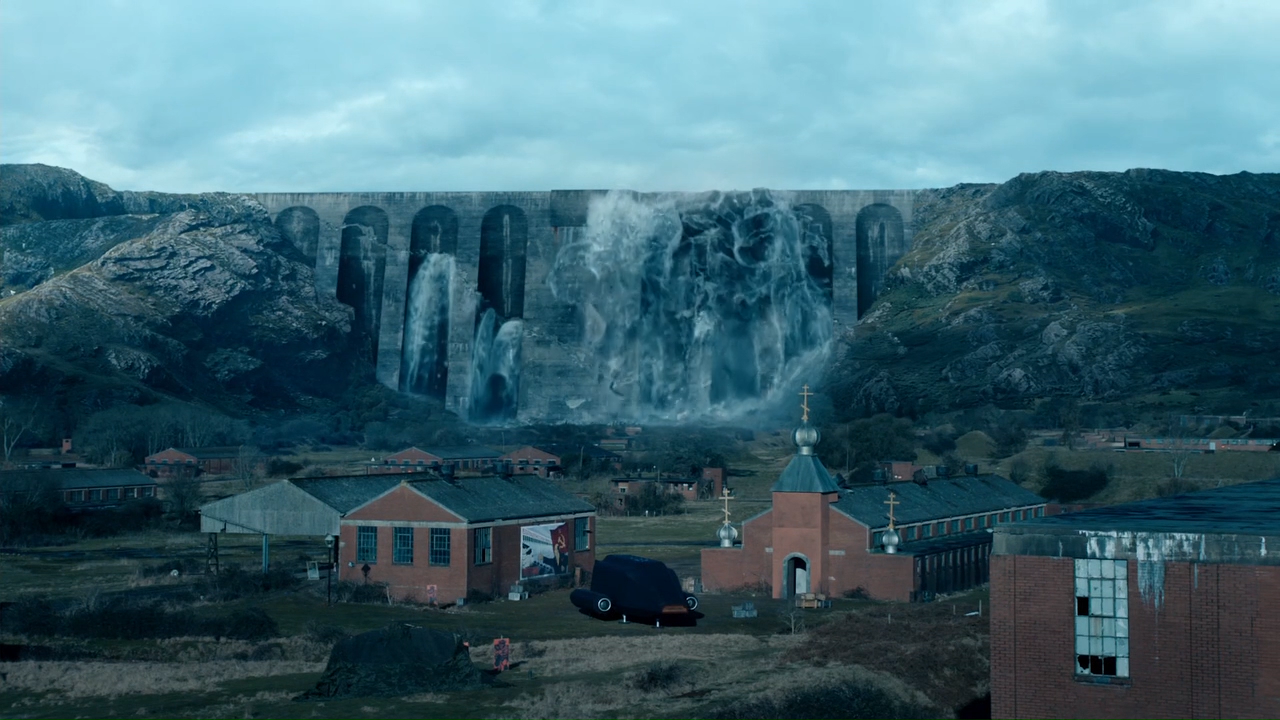
The drowned village/exploding dam images that have been used in other places are rather nice. The ghosts and exploding dam are good-looking SFX/make up, and the base is a nice set, even if it seems a little familiar. A dead average set of stories that starts good with an intriguing premise and then dips and dives to a dismal and boring bog-standard, run-of-the-mill ending.
My brother watched part of this with me and was slightly confused until I explained the bootstrap paradox (he missed the opening) and found the episode to be clever (in his defence, he doesn't have much experience with basic science-fiction concepts).
I would rate Under the Lake as a 6/10; it has an nice premise let down by a poor second half. I rate Before the Flood as a 5/10, so overall I would rate the combined total overall as a 6/10.