
The Underwater Menace
Doctor Who - The Underwater Menace

|
The Underwater Menace |
Target novelisation Doctor Who - The Underwater Menace |
|
| Author | Nigel Robinson | 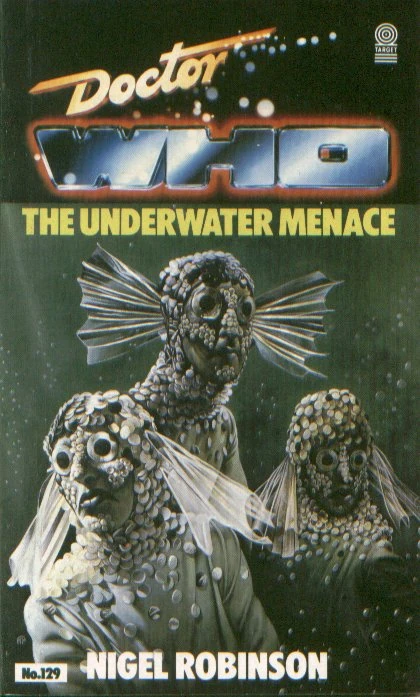 |
| Published | 1988 | |
| ISBN | 0 491 20326 7 | |
| First Edition Cover | Alister Pearson |
| Back cover blurb: When the TARDIS lands on a deserted volcanic island the Doctor and his companions find themselves kidnapped by primitive sea-people. Taken into the bowels of the earth they discover they are in the lost kingdom of Atlantis. Offered as sacrifices to the fish-goddess, Amdo, the Doctor and his companions are rescued from the jaws of death by the famous scientist, Zaroff. But they are still not safe and nor are the people of Atlantis. For Zaroff has a plan, a plan that will make him the greatest scientist of all time - he will raise Atlantis above the waves - even if it means destroying the world... |
The Prudence of Zaroff by Jason A. Miller 4/10/25
The Underwater Menace is an odd story on TV. It's fun, lots of fun, if you're in the right mindset. The music is nuts. The sets are nuts. The direction is nuts, like the two-minute Underwater Ballet of the Fish People in Episode 3. Joseph Furst is nuts as Zaroff, in a smart and commanding way: it takes a good actor to go that far over the top and become the story's center of gravity. Not too many human-villain actors in Doctor Who are able to do that. Graeme Crowden in The Horns of Nimon, obviously. Derek Francis in The Romans. Colin Baker in The Twin Dilemma (whoops).
But the seams are showing, and The Underwater Menace doesn't quite achieve greatness. It's only Troughton's third story, after all, and his character's not quite settled in yet. The guest cast is wildly variable: half the cast is on acid (Furst, Peter Stephens as the high priest), the other half is dead serious (Noel Johnson as King Thous, Tom Watson as the assistant high priest). The cliffhanger to Episode 1 --- in which Polly is strapped to a gurney and about to be surgically turned into a Fish Person --- is both of those things at the same time. So how to turn this into a compelling book? How do you make Zaroff interesting in print, without Furst there to animate his words?
Nigel Robinson's idea is to throw out the ending and make up his own conclusion. Here's what Robinson does: Lolem, the high priest, escapes the flooding of his temple and takes refuge in Zaroff's laboratory. After Ben and the Doctor escape execution by repeatedly kicking away Zaroff's gun, Lolem --- distraught over the loss of his temple, his world --- leaps out of hiding and engages in a struggle (TO THE DEATH!) with Zaroff. This prevents the latter from flipping the switch that will end the world, and allows the Doctor and Ben to escape the floodwaters. Religion. Science. Locked in a death struggle, even as the waters rise! A fitting metaphor for the rest of the story: Zaroff the scientist controlling the primitive fish-goddess worshippers of Atlantis ("Your people? Your people?! They are my people now!! I HOLD THEIR WHOLE WORLD IN MY POWER!!!" -- Joseph Furst, Episode 3), with Lolem the high priest fighting back with his bare hands (and, on TV, bare chest, not that Peter Stephens, bless him, was exactly body-by-Chippendales).
But, on TV, we had none of that. That ending never happened. On TV, the Doctor escaped by tricking Zaroff out of his lair, and Ben dropped the bars that separated Zaroff from his Death Switch. Zaroff then spent like ten minutes of screen time trying to reach through the bars to flick that switch... and drowns in the process. The greatest scientific mind ("in the vorld!") --- laid low, by his failure to just, like, grab a broomstick, or something. So that's why Robinson had to rewrite the ending.
The rest of the novelization is fortunately (or unfortunately) very faithful to the TV episode, although Sean, the stereotypical Irish character, referencing "closing time at Paddy Murphy's pub" is fortunately (or unfortunately) deleted.
Robinson --- perhaps aware, as line editor, that Target fans were shelving their books in story order rather than in publication or numerical order, and that new readers might not know much about new companion Jamie --- adds both a prologue and an epilogue to bookend the TARDIS scenes, and these serve as Jamie's major contribution to the story, as we see the TARDIS through his eyes. The Doctor, meanwhile, is at his most clownish, enjoying character traits that would promptly disappear in the next serial (he temporarily overcomes Zaroff by blowing a recorder full of pepper into his face). Robinson in the book highlights the Doctor's obvious buffoonery, especially in a scene where the Doctor is "upset" by his companions' pointed questions. Oh, and Polly is inadvertently topless; in an early scene, Robinson describes her entire outfit, except for her shirt. Whoops.
The chapter titles somewhat capture the schizoid nature of the TV serial. Naturally, Chapter 8 is titled "Nothing in the World Can Stop Me Now!" With exclamation point. Alas, that's undercut shortly thereafter by Chapter 10's clunky title "The Prudence of Zaroff". One would have to hope that was Robinson's way of being dry and ironic...
Something else odd is that the bonkers Episode 1 cliffhanger --- Polly on the operating table --- doesn't even get turned into a chapter-ender. The book is only 11 chapters, rather than the usual Terrance Dicks-standard 12 (with the cliffhangers going at the end of Chapters 3, 6, and 9), and this scene, terrifying on TV, just gets slipped into the middle of a chapter. The milder-than-warm-air Episode 2 cliffhanger does get to end a chapter, even though you'd be hard-pressed to remember it a day or so after watching.
In a nutshell, Robinson, like the TV script from which he worked, was just all over the map. Good stuff? Um, Zaroff's control center is appropriately dubbed by Robinson "the Power Complex". The Doctor, in one of his less competent moments (and in this story that's saying a lot) "wisely" declines to answer a question because "he wasn't too sure himself". But when Polly is told that the Fish People operation will be painless, she observes that she was told the same thing about her polio vaccine. Inappropriate, much, Nigel? And now, 20-plus years later, people are dodging the COVID vaccine... The Doctor, when waiting for the King of Atlantis to deliver what turns out to be a death sentence, compares the moment to "rather like waiting for the dentist". Later on, when the Doctor mentally lists his most fearsome enemies, Nigel rather cheekily sneaks the Drahvins onto the list (which I think Steven Moffat then borrowed for The Pandorica Opens...). Finally, when Jamie slaps Polly in the face, the author editorially adds:"That shut her up". Ugh.
On the whole, Robinson seems in turns bored and giddily enthused as he writes. Apart from the sloppy, clumsy prose moments noted above, there are also several moments where characters reflect on the story's overall lack of logic. "The Doctor had come up with some strange plans before but this surely was the strangest of them all," or, when Ben suggests attacking Zaroff with his own pet octopus, Robinson appends,"he asked in all seriousness". It's hard to know if this is badly written because of the source material or if it's just badly written, period. Based on the bulking up of the climax, I'll given Nigel the benefit of the doubt and assume he tried as hard as he could as long as he could before, like half the cast on TV, just plain giving up.