THE DOCTOR WHO RATINGS GUIDE: BY FANS, FOR FANS

|
BBC
Village of the Angels
|

|
| Story No. |
327 |
|
| Production Code |
Series 13, Episode 4
|
| Dates |
November 21,
2021
|
With Jodie Whittaker, Mandip Gill, John Bishop
Written by
Chris Chibnall and Maxine Alderton
Directed by
Jamie Magnus Stone
Executive Producers: Chris Chibnall, Matt Strevens, Nikki Wilson
|
|
Synopsis: The Angels have the Doctor.
|
Reviews
The Image of an Angel by Niall Jones
9/2/26
One thing you can't accuse Chris Chibnall of is lack of ambition. On making television during the height of the COVID-19 pandemic, he observed that 'there were two ways you could go'. 'You could go 'let's do lots of tiny episodes in one room, with no monsters', or we could throw down the gauntlet and do the biggest story we've ever done'. That Chibnall went for the latter option is admirable, even if the result proves that bigger doesn't always mean better.
Flux, a six-part story in which a good chunk of the universe is destroyed in its first episode, is certainly big, but it's not always good. While generally entertaining at any given moment, it fails to add up to more than the sum of its parts, and its final two episodes, Survivors of the Flux and The Vanquishers, make for genuinely bad television. While some of these failings can be attributed to Chibnall's limitations as a writer, there is a more fundamental reason why Flux never quite lives up to its ambitions: Doctor Who is simply not well-suited to longform storytelling. The series, particularly in its 21st-century incarnation, is all about variety, with the TARDIS zooming, not just between places, but between types of stories. Plot points are rarely developed beyond two or three episodes, and actions tend not to have consequences. In contrast, longform storytelling is all about consequences, about how events unfold over time and how characters deal with them.
Chibnall negotiates this limitation by splitting the difference between the miscellaneous structure Doctor Who is known for and the kind of serialisation that a six-part story implies. Each episode has its own story, but forms part of a larger plot, with some connective tissue running throughout. The degree to which these elements balance varies, with some episodes feeling more standalone than others.
Standing most proudly alone is Village of the Angels. Uniquely in the season, Village of the Angels was not written solely by Chibnall, but co-written with Maxine Alderton, whose Gothic horror The Haunting of Villa Diodati is seen by many as a highlight of Series 12. It's hard to know exactly how this collaboration worked, but the combination of the co-writing credit and the episode's distinctive feel may not be a coincidence.
In contrast to the frantic globe/planet-trotting of the rest of the series, Village of the Angels takes place largely in a single location, the fictional village of Medderton in Devon on 21 November 1967. There's only one main threat --- the Weeping Angels --- and, while the episode follows directly on from Once, Upon Time and leads directly into Survivors of the Flux, the plot is largely self-contained.
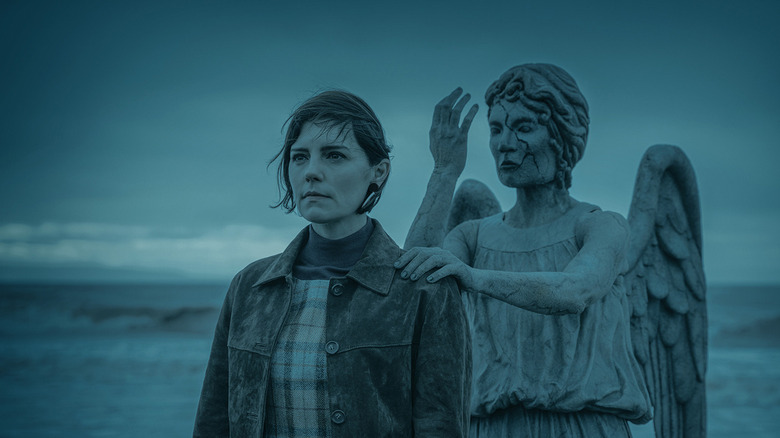
Bringing back the Weeping Angels must have been an easy decision --- after all, they remain the revived series' most iconic addition to Doctor Who's rogues' gallery --- while the nine year gap since their last major appearance in The Angels Take Manhattan means that their return here feels fresh. Although the story borrows from both Blink and The Time of Angels, it does enough that is new to justify bringing back the Weeping Angels. The emergence of an Angel from a sketch and, even more alarmingly, from the flames as the picture is burned takes the idea that 'that which contains an image of an Angel is an Angel' and raises it to new heights. The writers also develop the idea of the Weeping Angels as psychic beings. The scene in which the Doctor enters Claire's mind to negotiate with the Angel hiding there is beautifully shot by director Jamie Magnus Stone (grandson of former Mastermind host Magnus Magnusson). The depiction of this internal landscape as a beach is both striking and eerie, with its dreamlike symmetry and cold grey-blue colour palate.
Perhaps the most notable innovation with regards to the Weeping Angels, though, is their integration into the Division, the covert Time Lord agency that the Doctor was supposedly part of prior to their First Regeneration. The Division may be an obscure bit of lore developed unnecessarily in Series 12, but it's also the only hanging thread from the series that lends itself to further storytelling. Given the links between Weeping Angels and Time Lords suggested in The End of Time, their presence within the Division makes sense, putting a Chibnallian spin on an iconic Steven Moffat creation in a way that doesn't feel forced.
While the return of the Weeping Angels provides a compelling hook for audiences, the story's success is also a result of its strong supporting characters. The character of Claire Brown, a woman out of time, who also appears briefly in the series' opening episode, The Halloween Apocalypse, works well and is compellingly played by Annabel Scholey. Anchoring the story, though, is Eustacius Jericho, a scientist who studies Claire's psychic irregularities. Played by Kevin McNally --- whose previous Doctor Who experience was in much-maligned story The Twin Dilemma --- his stern exterior balances well against Jodie Whittaker's energetic Doctor. He also gets the episode's most powerful piece of dialogue.
Under siege from the Weeping Angels, he tells the Doctor that 'I've seen many things beyond my comprehension […]. I was one of the first British soldiers into Belsen at the end of the War. If you think a few stone statues will destroy my equilibrium, you are mistaken.' This line not only emphasises Jericho's fortitude, but also highlights the degree to which an entire generation was quietly shaped by its experience of the Second World War. Belsen was the first concentration camp to be liberated by the Allies, and BBC journalist Richard Dimbleby's graphic report from there was among the first the British public learned about the evils of the Holocaust. In the 1960s, most men in middle age or above would have seen or done something similar. Even such a notoriously dull figure as 1970s prime minister Ted Heath landed on the beaches of Normandy and oversaw the execution of a Polish soldier convicted of rape and murder. Jericho's reference to his experiences in the War is the sort of small moment without which the episode would be far less rich, providing a brief but illuminating insight into the mind of an almost-vanished era.
The series' regulars are also done well, with the strong script eliciting top performances from both Jodie Whittaker and Mandip Gill. The Thirteenth Doctor comes across as instantly authoritative, while the writers' decision to separate the Doctor from her companions gives Yaz a meatier-than-usual role, as she gets to use her policing skills to look for missing girl Peggy. The only character shortchanged is new companion Dan, who has very little to do, suggesting that it may have been better to have had Yaz travel with the Doctor alone.
For all its strengths, though, there is one problem with Village of the Angels. While the link between the Weeping Angels and the Division would have been enough to integrate the story into the wider Flux plotline, the episode also includes a series of space-set scenes in which Bel searches for her 'life partner' Vinder. These scenes are not necessarily bad, but they do feel out of place, having no connection to the rest of the episode, and their inclusion distracts from the more interesting story being told. The decision to interrupt the credits with more of Bel's story also gives it a prominence that, it will soon become clear, it doesn't deserve.
While Chibnall has to be applauded for Flux's never-say-die ambition, the success of Village of the Angels compared to the rest of the series suggests that, sometimes, Doctor Who does better on a small scale. In the end, a single house in a small village can offer as much drama as whole expanses of space.