THE DOCTOR WHO RATINGS GUIDE: BY FANS, FOR FANS

|
BBC
Wild Blue Yonder
|

|
| Story No. |
333 |
|
| Production Code |
Series 14 special
|
| Dates |
December 2,
2023
|
With David Tennant, Catherine Tate, Bernard Cribbins
Written by
Russell T Davies
Directed by
Tom Kingsley
Executive Producers: Russell T Davies, Julie Garner, Jane Tranter, Joel Collins, Phil Collinson
|
|
Synopsis: The Doctor and Donna explore a deserted ship on the edge of the galaxy.
|
Reviews
Everything you know is (a little bit) wrong by Stacey Smith?
18/9/25
Donna Noble sang the titular Wild Blue Yonder song in school... only it's not called that. The song is actually called "The U.S. Air Force", although it was originally titled "Army Air Corps" before World War II, and it's the official song of the United States Air Force. Her teacher, Mrs. Bean, thought it was jolly, even though her grandfather said it was a war song, but how Mrs. Bean could deny that when the title clearly ---
I'm sorry, what? Donna Noble, born in Southampton, grew up in Chiswick, sang a U.S. Air Force song in her British school? Why on earth would she do that? Why wouldn't she be singing "Those Magnificent Men in Their Flying Machines" or something? This is the sort of thing that sounds perfectly reasonable at first, but it's just downright bizarre the more you think about it.
That pretty much describes Wild Blue Yonder to a T.
The trailer for the three specials barely showed anything from the middle episode. Partly that's because it's hard to do without giving the game away, and partly that was because we now know that the production team wanted one of the episodes to be pure surprise, but it also had the effect of setting up Wild Blue Yonder as a curiosity. What on Earth was happening here that they couldn't even edit more than a few scenes into the trailer?
The wrongness starts with Isaac Newton, and it's not just the colour-blind casting. Back in Classic Who, plenty of white actors wore blackface or yellowface, because that was the style of the times. The style of today is exactly what we get with Nathaniel Curtis playing Newton, so I have no problem redressing the balance here. No, the first thing that's weird about this scene is its very existence: what it is even doing in this episode? The light-hearted tone and breezy feel are completely at odds with the bulk of the story on the spaceship. It's apparently just a random comedy add-on with no connection to anything else.
The second thing about this scene that's weird is the "mavity" joke. Not because it's a strong joke (it's not), but because it's played for real throughout. The Doctor and Donna are gone before Newton even says the word "mavity", yet they use it multiple times throughout. The Doctor only uses the word "gravity" once in the future, and Donna doesn't understand what he means, so he corrects himself and says "mavity" instead. The only thing we can surmise is that they changed the timeline by crash-landing in that tree, and Donna has now never heard of the word "gravity". Which is fine, I guess, but... why? And yet, for all that, "mavity" has a staying power and became a meme generator, so even the wrongness here is somehow right.
There's a theory that the second story of every new Doctor could be a Hartnell story. After a whizz-bang introduction, the second stories tend to be quieter and more thoughtful, showing the investigative nature of the new Doctor in a place of wonder. That pretty much holds up here. Yes, the special effects are... let's say "bigger" than anything the Hartnell era could have conceptualised, but the fundamental story involves the TARDIS crew exploring what appears to be a deserted structure and finding monsters that look like them and have their memories, using heightened emotions to gain strength, so they rile up the character attacks. This could have been written by David Whitaker as a way to get to know the TARDIS team.
However, the wrongness comes from so many different angles. The HADS is a continuity reference from wayback, except that a) it works quite differently here and b) the TARDIS re-appears just as the ship is exploding, which is kind of the opposite of avoiding hostile action. The Doctor knows 57 billion languages... but why would he, when he has a universal translator accompanying him at all times? The Doctor is suddenly bi, for the first time ever, and says the word "bum" in precisely the way he never did. The technobabble about the universe actually having an edge is so clearly fan service to explain a scientific error in Planet of Evil... and then they go ahead an contradict it a few seconds later when the Doctor says he's never been this far out. None of these are necessarily strange on their own, but the sheer mass of them in this single episode adds up.
Jimbo the robot is a marvellous addition, moving slowly to the countdown because it's just a very old robot. I love the aged futurism here, contrasting with the gleaming spaceship and the futuristic hovercar. Only, in retrospect, why is the first step we see taken out of synch with the countdown? Fenslaw happened quite a while before we see Jimbo's first step, whereas all the others are synched to the the announcements. It's all just slightly wrong.
The fact that the spaceship countdown works in Base 10 is itself pretty strange. Base 10 is natural for us because we have ten fingers, but not even every human culture uses it. The Mayans used Base 20, the Egyptians Base 12, and the Babylonians used Base 60. So why would a race of bipedal horses in the far future be using Base 10 for their countdown? And would the Doctor --- the man of science and learning and super-fast thinking --- really read numbers on a screen that he then couldn't recognise when said out loud? I can't stand the confusion in my mind!
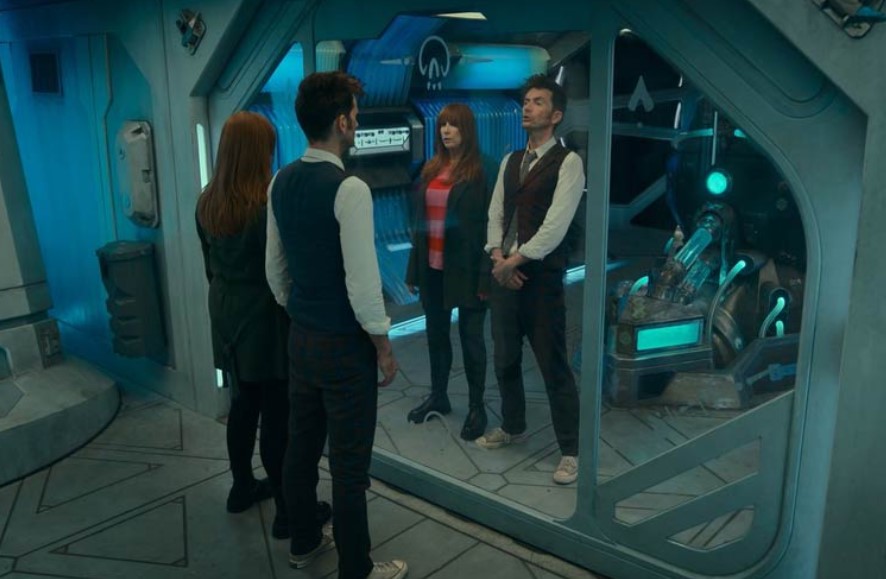
Then there's the duplicates, of course. They look wrong, and they act wrong. They're described as "not-things", and their very raison d'etre is to be creepy and slightly off versions of something familiar and comforting. This happens both diegetically and non-diegetically. Because they adapt only when emotions are heightened, they need to frighten and push the Doctor and Donna into charged situations, mentioning hot-button topics like Gallifrey, Wilf and the Flux.
This works brilliantly when each pair is trying to figure out who's real. What's especially clever is that Donna succeeds where the Doctor fails. He tries to use logic but is taken in by the deep emotions of not-Donna's insight into his recent past, only escaping by chance because she couldn't hold her form. Conversely, Donna fools the not-Doctor by running off her mouth about her Aunt Iris and then deducing his nature from the missing tie. It's a masterclass in character, because Donna gets emotionally charged about even minor things, so she uses that as a distraction, because the not-things can't tell the difference. Conversely, the Doctor is much more an intellectual, burying his deeper emotions, which means he's more susceptible to having his demons released, culminating in the scene where he punches the wall because they've played him so well.
A key moment in the 14th Doctor's arc occurs when he stares at the not-Doctor and knows for a fact that it doesn't understand why the captain threw herself outside... because he knows his own face. If this were an original regeneration, that wouldn't have worked at all, but this scene is built on the fact that the 14th Doctor is reusing his tenth face. This is another example of things seeming reasonable but actually being quite, quite unexpected, because the Doctor has never had this kind of confidence in himself in the second adventure of a new regeneration. (Think The Beast Below, when Amy knows him better than he does, because she's spent a decade thinking deeply about who he fundamentally is, while he's only known his eleventh self for a few hours.)
The climax sees the Doctor inadvertently taking the not-Donna with him in the TARDIS, because she gives a funnier answer to his question about Mrs. Bean. ("It just is!") This is the sort of Donna line that would have a live audience cheering in response. However, both answers are perfectly Donna, indicating that the copy has almost precisely perfected her. The Doctor realises his mistake by noticing that her arms are 0.06 millimetres too long, but this kind of technobabble explanation is much weaker than one arising out of character would have been. There's some precedent for this: the Doctor only recognised the fake Martha in The Poison Sky because of a technobabble explanation, rather than because he intrinsically knew her, but it still feels wrong here, because the contract with the viewer is that the Doctor and Donna are intimately connected and hence should fundamentally know each other.
Leaving the true Donna behind to face the exploding ship almost makes it look like the show was going to kill off the real Donna and let the fake one travel with the Doctor. That would have been a bold move, dramatically superior to the twee ending we got... but Doctor Who isn't the kind of show to kill off a beloved character. There would have been riots on the street had they killed off the beloved Donna, especially after rehabilitating her Series 4 ending in The Star Beast. But how much more brilliant would The Giggle have been if the Doctor had been travelling with the not-Donna? And there could have been a get-out-of-jail-free ending here too, if the real Donna had turned in surprise at the last moment --- only for The Giggle to reveal that she was being rescued by the Ncuti Gatwa Doctor. Ah well, sadly they don't let me write for the show...
In the final TARDIS scene, Donna tells the Doctor that only the not-Donna could see into his past, but it's pretty clear from her body language that she's lying. Likewise, the Doctor shuts down and avoids talking about his trauma with her, saying that it will take a million years for him to be okay. Donna had earlier pointed out that even after all this time, they didn't stop to just talk, only that was to the not-Doctor. Once again, they're supposed to be reunited because of their close connection, only they talk past each other and withhold stuff from the other, unable to face up to the emotions that the not-things generated. Wrong, wrong, wrong.
In the coda, we inadvertently end up with Wilf's final scene, which feels completely out of place for this episode, let alone that this was his last-ever appearance. Wilf so clearly should have been in The Giggle but sadly died before he could film those scenes. And yet, his appearance at the end here is as bizarre as the Isaac Newton scene at the beginning. Both sit very oddly against the claustrophobic and tense action on board the spaceship, feeling as though they belong to entirely different episodes.
To a casual observer, Wild Blue Yonder looks like Midnight with a larger budget and smaller cast. But dig deeper, and it's so much more than that, set at a strange angle to reality even before the weird clones show up. It draws on sci-fi movies like 2001 and Us to create tension, while being a character study of two beloved leads that nevertheless manages to keep everything off kilter. It looks like a typical Doctor Who story, but it's most certainly not, largely because everything is ever-so-slightly wrong. In the end, all we can really do is appreciate the mavity of the situation...
Here They Come, Zooming to Meet Our Thunder by Niall Jones
25/3/26
A ship on the edge of the universe. It appears abandoned. No signs of life. It's a setup that goes back to the very earliest days of Doctor Who. It's about exploration and discovery, mysteries and questions. Wild Blue Yonder is an exercise in stripping Doctor Who back to its very essence, its premise recalling early stories such as The Daleks or The Sensorites, but there's nothing nostalgic about it. Instead, it's a strange, uncanny episode, in which the familiar is rendered grotesque and other.
To start with, there's the TARDIS. Following an unfortunate encounter between the console and a cup of coffee, the TARDIS malfunctions, taking the Doctor and Donna to an abandoned spaceship on the edge of the universe, via a brief, but bizarre, trip to see Isaac Newton. There's nothing inherently odd about this --- after all, the TARDIS literally has a mind of its own --- but the way in which it takes place is strange and off-kilter. It crashes, ejects its passengers, plays music, then dematerializes. To put it mildly, this is not normal TARDIS behaviour.
The exact music played is important, and also rather odd. 'Wild Blue Yonder' is not a song that many British viewers will likely be familiar with. I for one had never heard of it prior to watching this episode. As Stacey Smith? points out in her review, it's properly called 'The U.S. Air Force' and is the official song of that organisation, so it's odd that Donna is so familiar with it, even having sung it in school. There is, however, something strangely right about all this wrongness. When the Doctor and Donna discuss the song, Donna admits to having previously misnamed it 'Wide Blue Yonder'. The difference between the two titles amounts to only half a syllable, but is nevertheless significant. This slippage between two near-identical sets of words not only foreshadows the episode's later doubles, but also hints at their underlying violence. 'Wide Blue Yonder' suggests inspiration, gesturing at the vastness of the sky or space; 'Wild Blue Yonder', in contrast, is altogether more turbulent and dangerous. It is, as Wilfred Mott once reminded Donna's teacher, a war song.
Why the TARDIS plays the song, even why it brings the Doctor and Donna to the ship, is never explained. Thematically, the playing of a war song anticipates the 'blood, fury and hate' referenced later in the episode, but the plot rationale for its inclusion remains obscure. You could try and rationalise the Doctor and Donna's arrival at the edge of the universe by arguing that it's all down to Sutekh, who, it is later revealed in Empire of Death, has (somewhat improbably) been clinging to the TARDIS ever since the events of Pyramids of Mars. You probably shouldn't try to do this, though. As a solution, it makes a sort of sense --- after all, it is the Doctor's invocation of superstition that allows the Pantheon to gain a foothold in our universe --- but it's also convoluted and unsatisfying. It is far better to see the lack of explanation as the point. It introduces a sense, not just of danger --- as Donna puts it, 'there's something on this ship so bad the TARDIS ran away' --- but also of paranoia, a sense of the world turned upside down.
From the moment the Doctor and Donna begin to explore the ship, it is clear that they are being watched. By framing them in first-person shots, shown as if from behind an invisible pair of eyes, director Tom Kingsley ratchets up an atmosphere of paranoia. This atmosphere pervades the episode, such that, while nothing much happens in the first twenty or so minutes, the audience is nevertheless left with a feeling of constant dread.
This feeling builds until the appearance of the Not-Things, the story's uncanny adversaries. Their initial appearance is both sudden and subtle, highlighting their insidious nature. The camera cuts from the Doctor talking to Donna, to the Doctor on his own. It's a slightly jarring moment, but not one that can't be explained. Then Donna walks into the scene and it becomes clear that something is very wrong. The camera then cuts back to Donna and the Doctor --- in the other room. What's particularly clever about this scene, in which two parallel conversations begin to take place, is that the wrongness is embedded before the audience even notices. It eventually becomes clear that there are two Doctors and two Donnas, but this revelation comes with the disturbing recognition that this has in fact been the case for most of the scene. Here, the plot runs ahead of the audience in an unsettling way. It suggests not only that you can't trust what you're seeing now, but also that you can't trust what you've just seen.
Doppelgangers are uncanny by their very nature, but what is particularly eerie about the ones depicted in Wild Blue Yonder is their physicality. They may look and sound exactly like the Doctor and Donna, but their bodies are fluid, unfixed. Absurdly long arms or eyes out of all proportion to faces, impressively rendered through prosthetics, distort the time travellers' appearances in grotesque ways. The Not-Things' uncanniness is therefore not understood intellectually, but instead felt viscerally. They are physically disturbing and scary in a way that few Doctor Who monsters are. Although Wild Blue Yonder contains echoes of Midnight, particularly in the manipulation of speech, the Not-Things' closest cousins appear to be the Boneless from Flatline. There are clear parallels between the two sets of antagonists: both are malicious beings from beyond the known universe, unfamiliar with the nature of our reality.
That unfamiliarity, however, isn't the whole story. As the story unfolds, the Not-Things become steadily more at home in our universe, able to keep their shape more permanently and convincingly. For me, this echoes the contemporaneous development of AI. In fact, AI feels like a major touchstone for the way in which the Not-Things are depicted. That they are initially betrayed by physical distortions parodies the way in which AI image generators, such as Dall-E and Midjourney, have struggled to convincingly depict hands. In a 2023 interview, computer scientist Professor Peter Bentley told BBC Science Focus Magazine that AI tools are '2D image generators that have absolutely no concept of the three-dimensional geometry of something like a hand'. They may get 'the general idea of a hand. It has a palm, fingers and nails but none of these models actually understand what the full thing is.' The same is true of the Not-Things --- as the Doctor's doppelganger puts it, 'the notion of shape is strange'.
Despite this, it's not clear if the Not-Things are intended as metaphors for AI. The episode may include a version of the Turing Test, with the Doctor inadvertently inviting Donna's doppelganger into the rematerializing TARDIS, but it ultimately fudges its conclusion by rendering the test irrelevant. The Doctor works out it's not Donna for an entirely unrelated reason. Nevertheless, it is striking that Russell T Davies chooses to develop themes drawn from the development of AI and does so in such a negative way. It's perhaps unsurprising, then, that AI would go on to feature as a central theme in 2025's The Robot Revolution. Imitation in Wild Blue Yonder is a source of terror, literally stemming from a void. What makes it so disturbing is not just the Not-Things' malicious intentions, but the way in which their near-seamless impersonations of the Doctor and Donna are underpinned by a total lack of sincerity. They can say the sort of things the Doctor and Donna would say --- can convincingly project humour or empathy --- but mean absolutely none of it. If that level of imitation were to be achieved by an AI system for real, it would justify any amount of paranoia.
Wild Blue Yonder is a taut, atmospheric and thoughtful piece of sci-fi. More properly, it is a taut, atmospheric and thoughtful piece of sci-fi that follows on from a silly bit of comedy involving Isaac Newton. At first glance, the inclusion of the opening scene, which is tonally at odds with the rest of the episode, is baffling. However, it starts to make sense when you consider Wild Blue Yonder in its wider context.
The three specials starring David Tennant act as a bridge, necessitated by Ncuti Gatwa's delay in taking on the role of the Doctor, ensuring that the show wouldn't be off-air during its 60th anniversary year. Their existence is therefore a celebration. Together, the three specials form a hyper-condensed series of Doctor Who, with each one celebrating a particular aspect of the show (or at least Davies' vision of it). The Star Beast is an action-comedy, of the kind that opened Davies' first four series as showrunner, and shows how much fun Doctor Who can be; Wild Blue Yonder is an unapologetically strange and ambitious piece of sci-fi, of the kind that usually comes two-thirds of the way through a series, and shows how conceptually bold Doctor Who can be; The Giggle is a (literally) all-singing, all-dancing finale, of the kind that always ends a series, and shows how big Doctor Who can be. This list is far from exhaustive, though. Absent from it is a common Doctor Who genre: the celebrity historical. Rather than miss it out altogether, Davies instead compresses it down as far as it will go and affixes it to an unrelated episode. Whether or not this is a good idea is debatable. Beyond simply showing that the Doctor sometimes travels back in time and meets historical figures, the scene's main significance seems to be to introduce the concept of 'mavity', a joke that is mildly amusing at first, but which becomes steadily more annoying as it is repeated in Series 14 and 15.
Despite this, Wild Blue Yonder is a great episode. It's the boldest and most original of the three specials and has a wonderfully disturbing sense of the uncanny. The juxtaposition of a simple premise with a relatively complex yet stripped back plot also returns Doctor Who to its roots. As an example of the show's ability to move in strange, unsettling directions, it stands out as an unqualified success.