THE DOCTOR WHO RATINGS GUIDE: BY FANS, FOR FANS

|
BBC
The Woman Who Lived
|

|
| Story No. |
281 |
|
| Production Code |
Series 9, episode 6
|
| Dates |
October 24,
2015
|
With Peter Capaldi,
Jenna Coleman
Written by
Catherine Tregenna
Directed by
Ed Bazalgette
Executive Producers: Steven Moffat, Brian Minchin.
|
|
Synopsis:
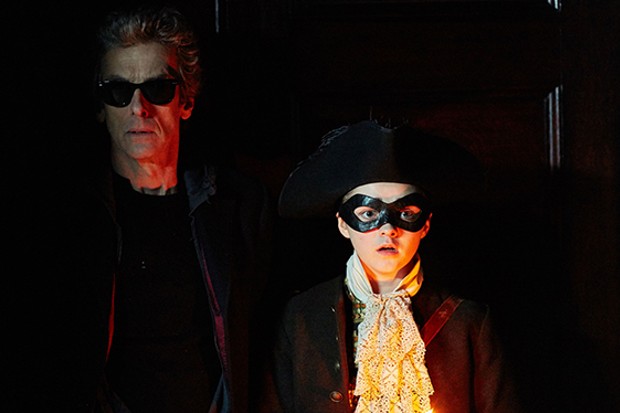
The Highwayman known only as The Knightmare is robbing stage coaches. So why does the Doctor find him so familiar?
|
Reviews
"She'll blow away like smoke" by Donna Bratley
13/7/19
Even lower on action than on Clara and featuring a villain about as menacing as a half-chewed mouse, I really shouldn't like this. Being inconsistent, I do.
As a sober character piece, and an examination of immortality's true cost, it's beautiful: poetic and thought-provoking in equal measure. The Doctor knew his rash actions among the Vikings would have consequences. Now he starts to see them writ large.
It's not Maisie Williams' strongest outing, and "Me" is an irritatingly confusing pseudonym, however poignant the backstory. She struggles with her flowerier dialogue, and can't help but sound shrill - annoying - in her more tempestuous moments. That's hardly her fault; teenage girls have high voices and a tendency to become petulant when crossed (as a former teenage girl, I can say that), and while she may be several centuries old, the immortal still has her original vocal chords.
In the lighter moments, Williams fares better and (naturally) her rapport with the Doctor is a delight. Whether they're bickering over housebreaking skills or the Knightmare having "Dad" as a sidekick, the edgy, uncertain dynamic is a complete break from the easy confidence of his relationship with Clara. Much as I love her, a change is as good as a rest.
Ashildr is less a person than a case study in the dangers of living forever; seen that way, she's mightily effective. Catherine Tregenna's first Doctor Who script is an acute psychological examination that would have worked more smoothly without the inclusion of a risible "monster of the week" in the form of Leonardo the Leonian from Delta Leonis.
Yes, I get it. It's a space lion!
The Doctor's renaming is admirably succinct for a bloke in a dud mask and a cardboard crown. Next!
While I'm focussing on the negatives, the direction is slapdash compared with the norm (and has to be for me to notice). There are a couple of frames as the Doctor gallops to Tyburn where the wooden head of a prop horse is painfully front-and-centre. Surely someone could've picked that up in the edit, since I did in a few seconds on broadcast!
There's also one very abrupt cut as the Doctor and Me attempt to sneak past the slumbering master of the house. It's a split-second thing, but it jolts me out of the action every time.
The concept behind the Eye of Hades is clever (although the light stream's pretty shoddy); that the Doctor stumbles across Ashildr when he least expects it is amusing. Rufus Hound as Sam Swift the Quick - a little bit slow, as the Doctor drily observes - is far more restrained and effective than I was expecting, while delivering some of the most risque lines ever to grace the show. The fairground crowd out to enjoy the spectacle of a hanging is unseemly but believable (it's a bit bucolic for seventeenth-century Tyburn, surely?), although it's a pity they're not a bit more terrified by a lion-man and a split sky spitting firebolts. A bit of vague running around and screaming... again, it's probably a flaw in direction.
I can forgive the irritants, because the beauty of the dialogue and the charisma of the central duo bring me back far more often than I'd expect.
What does immortality mean? Jack Harkness' version never rang true: too glib, too easy. Ashildr's human memory being unable to retain the vastness of her experience and the embitterment that comes of endless loss seems far more plausible. It's a grown-up take on a subject that the series has previously skimmed, combining minimal action with maximum characterisation. If balance is beyond us, I'd sooner have the scales tipped this way.
Particularly with this Doctor. The pained realisation that this is, as Me exclaims, what he made of her lies at the story's heart, and it's to Tregenna's credit that the rights and wrongs of both sides are presented so starkly. The Doctor's motives were kind: to save a terrified young girl. Ashildr's experience has coarsened her, but the brave, big-hearted storyteller who saved a village is still there. She's impatient; constrained within a world that moves too slowly, willing to risk anything to escape it.
She's never entirely evil. I can empathise with her.
She can be callous; her heart, as the Doctor poetically puts it, rusted. Those moments of chilling coldness are amongst Williams' most effective, and they're what make her sudden, shattering recovery of Ashildr's humanity work.
It's unsurprising of course: she took the first excuse to avoid murdering the devoted Clayton and cried out on instinct to halt Leandro's assault on the Doctor. At the last, aware of the hell she's brought upon an unsuspecting world, she reacts without hesitation to reverse the damage she thought she was willing to do.
Like the Doctor, she can't stay on the wagon; she has to get involved, to care. Even if - like the Doctor - she'll need the mayflies to keep her from staring too far beyond the next horizon.
The tension between the two - setting up the series finale - is deliciously vague. Does Ashildr really regard the Doctor as her friend? Does he trust the "tidal wave" of his own making? She's a remarkable woman, he's right about that, but this isn't Doctor Who cutting its occasionally judgemental line across the writer's own right/wrong divide. It's about the shades of grey we all deal in, and the compromise between personal desire and the wellbeing of others that make Ashildr human - comprehensible - despite her unimaginable lifespan.
That's the brilliance - and the beauty - of the episode before it all turns with Clara's tender, playful reappearance. She's completely secure in his affection (and small wonder, now he's using the TARDIS to help her pupils with their homework; there's a change since The Caretaker) and blithely, dangerously confident of "not going anywhere". The daft old man can see the warning signs, even without the unnerving appearance of a familiar face at the back of Evie Hubbard's selfie-present.
It's a fittingly ambiguous end to an intriguing piece of character work.
A Review by Thomas Tiley
11/11/25
While tracking down an alien gizmo, the Doctor stumbles across a highway robbery in process, resulting in him reuniting with Asildr, who now calls herself Me. She tries to get the Doctor to take her on as his travelling companion while she helps him retrieve said alien device whilst secretly plotting with a hooded lion man alien. Tonally, the episode is all over the place, going from very broad comedy to drama and back again.
Veering from learning about Me's dead children and her swearing off any connections with her fellow man and wanting to leave Earth because she can't stand to be around us anymore to standard comedic breaking-and-entering scenes, cat calling and slapstick in her scenes with Rufus Hound and a borderline --- no downright insulting --- scene featuring some very stupid comedy town guards that the Doctor bribes.
The opening scene with Me holding up the coach only for Capaldi to swing on by, acting as Tom Baker-like as he can, demonstrates the worst qualities of this style of comedy. Whereas past stories would have had the Doctor stop in his tracks at being held at gunpoint, this one has him ignore the threat to try and be funny. (Previous Doctors would have made a smart remark or comment or joke, and I can see the fourth Doctor try and get away with this sort of thing, but behaviour like that would have been shut down quickly with a rebuke or him getting knocked out in a past series; this just has the Doctor get away with it because Ashildr knows him). I mean, I like the occasional laugh but this?
Comedy has been a major part of Doctor Who from the beginning, but it has to have its place: too little and it's humourless and dull; too much and it comes across as a parody not taking itself seriously, and if the Doctor doesn't take the situation/villain seriously how can the audience? Basically it takes the worst excesses of the later Tom Baker series where the programme didn't take itself seriously and went too silly and runs with it.
It is important I guess to show the range of human life, tragedy and comedy, the lighter, nicer bits making up for the darker, sadder moments of our lives, which I think the whole execution/hangman scene between Capaldi and Hound (not to mention the various chats between the Doctor and Me) were broadly about. Whether the viewers like that sort of thing is another matter.
Capaldi is excellent as he usually is, although much of the plot of this episode could have been avoided if his Doctor took some responsibility. I especially liked the various dad jokes between him and Rufus Hound's character, like his shock at the low reward offer and the sight gag of his silhouette on the wanted poster. He gets a lot of good lines and jokes.
Maisie Williams isn't the greatest actress, being a bit hit and miss with her scenes, but she does a fairly god job as Me. There are some fairly good sequences with her but also some that fall flat such as the Doctor proclaiming that she loves her servant too much to sacrifice him, but based on the short scene we see between them it's hard to see what made him think that (true, she employs an old almost deaf and blind man, but that's as much a cover for herself and her activities than out of genuine concern for him). Her little flashbacks are rather good and in the case of the reveal of her deceased family rather affecting. Her final acceptance of her fellow man however seemingly comes out of nowhere (if seeing some villagers run around and scream in terror is all she needs, then she must have had a seriously bizarre personality switch), and the less said about the logic of her hanging around a pub having a conversation with the Doctor surrounded by people who had just seen her unleash a death vortex in the sky, the better. Rufus Hound's scenes depend on whether you like his style of comedy so are either okay or irritating; it was 50/50 for me.
The monster has an interesting design, truly lovely to look at, sort of like a redesigned Tharil, but Leonardo (or whatever his name is) has nothing much to do. The plot regarding Ashildr could have been easily written to have no alien involvement, but he is here because this is a historical episode, and modern Who can't cope unless there are alien menaces to eat up the time and budget. A very fairytale-like appearance that fits in with his quest for the eye of Hades: an amulet that uses a person's death to open a portal to another realm described by the Doctor as being like the afterlife. Much like the Fisher King in fact. Using the bog-standard alien lying and acting nice/pretending to a refugee to get sympathy and manipulate people for their own ends/evil plans... something we have seen multiple times in the new series and its spinoffs, starting with The Unquiet Dead and Torchwood's Greeks Bearing Gifts. I think it's only in the Sarah Jane spinoffs that it's been played straight (as in the alien is being genuine and is grateful for being helped and doesn't end up turning on its helper and being evil).
I do feel sorry for the chap under all that make up and prosthetics and heavy clothing; that would have taken hours to do, it must have been a nightmare to get into and out of. He could be the greatest actor in the world but with dreadful generic speeches and just standing about in the shadows, he won't get to show it. His end is just as boring being either vaporized or teleported away after he fails. He seems surplus to requirement; a version of this story with no aliens (something Doctor Who hasn't been smart or brave or adventurous enough to do since the 80s) or just the alien gizmo the Doctor finds could work just as well. It's such a shame he has to turn into an uber-generic bad guy who turns on his ally within seconds and ends up defeated just a as quickly. Like I said earlier, he is a fairytale character come to life, so why not play along with that? Let him open up a portal to the other realm (yes, someone has to die but he was going to hang anyway) but instead of an alien invasion fleet and death rays without targeting computers you get a genuine portal to another world/afterlife and him offering to take Lady Me hand in hand with him. Have the Doctor argue and try to win her over and have her choose between Life/Earth or go with Leonardo Death/Not Earth. It's a simple, beautiful idea that escaped the story's author who goes for the stupid and obvious.
Story-arc wise, it sets up the immortal Ashildr and her strained relationship with the Doctor. Him asking if they are friends or enemies near the end is a great moment, her appearance in the photo at the end being rather ominous although you would think the Doctor would warn Clara to be on the watch for her wouldn't you, instead of being silent. And of course Ashildr tells the Doctor point blank that one day Clara will die, setting up the series finale.
It's nice to see a story set in this time period, and the production standards, costumes and alien makeup are very good. The brief alien SFX scene is also all right for what little we see of it, but it's an aspect of the story that as I have already mentioned could have been done away with had they gone for a more inventive story rather than a derivative one. In rating this episode, I would take in to consideration that it is well made and acted for the most part but has some plot issues and wasted story elements that mar a otherwise fine story and make it rather average.
Five out of Ten, maybe bumping it up to a six or down to a four for creating/wasting a nice-looking alien design.